Bluish Women

And speaking of exotic Orientalism, how about these?
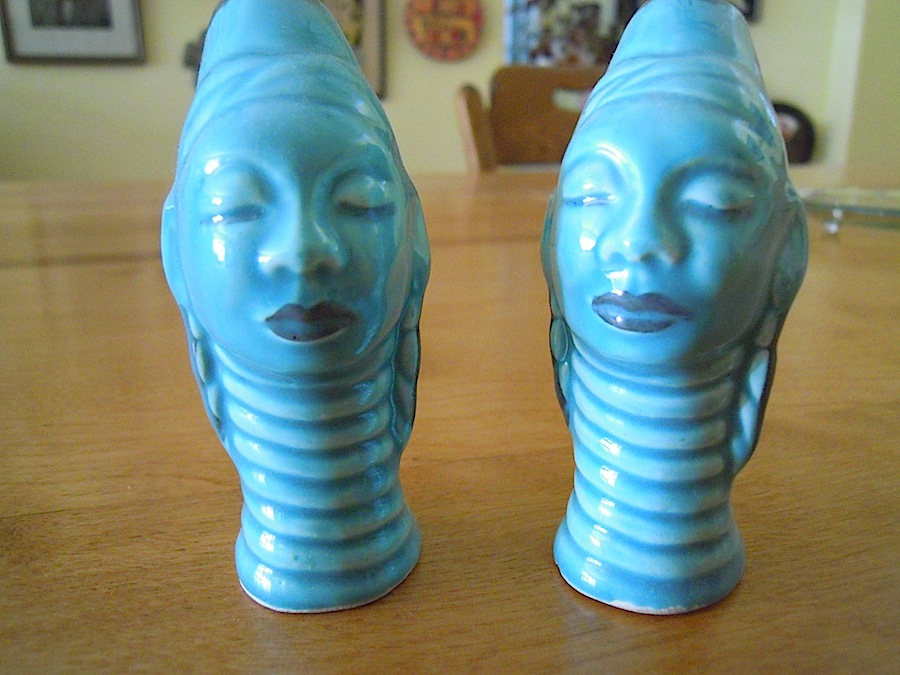
When I first looked at them, I thought that they were supposed to the sort of imaginary Africans who used to appear in the cartoons and comic books of my long-ago youth–the kind whose strange customs included various sorts of bodily mutilation, including the use of too many necklaces to elongate their necks.  A short Google search, however, reveals that the originals of this cartoon stereotype were not African at all, but rather, Burmese  (thus confirming the extent to which Ortentalist thinking removes distinctions like those between Africa and South East Asia and as in those old cartoons, just turns everything Out There into the mysterious East).  In Burma, according to Wikipedia,

Women of the various Kayan tribes identify themselves by their different form of dress. Women of the Kayan Lahwi tribe are well-known for wearing neck rings, brass coils that are placed around the neck, appearing to lengthen it. The women wearing these coils are known as giraffewomen to tourists.

Girls first start to wear rings when they are around five years old.  Over the years the coil is replaced by a longer one, and more turns are added. The weight of the brass pushes the collar bone down and compresses the rib cage. The neck itself is not lengthened; the appearance of a stretched neck is created by the deformation of the clavicle.

Here’s an example:

The Wikipedia article goes on to offer a range of explanations for this practice, none of them necessarily accurate, and so I won’t repeat them here.

So maybe my shaker set is not so completely Orientalist after all, but merely anthropological.  Except for one thing:  they make no claims to being Kayan or anthropological or anything else specific at all.  They exist in a void of specific explanation easily filled by generalized assumptions like those of my memories of Africans in cartoons.

Oh, and one other thing: unlike my shakers, the Kayan woman in the Wikipedia photograph is not blue.

So why are my shakers blue?  Good question–and one for which I really don’t have an answer.  Except, of course, that it makes the women depicted yet more exotic, yet more alien (and these shakers were, I’m sure, made long before the James Cameron movie Avatar raised blue exotica to new heights and new popular acceptability).

Another possible answer also occurs to me: making the shakers blue is an additional way of dehumanizing them, of making them into ornamental decor that elides their reference to an actual existing group of people, none of whom are actually blue–thus allowing the kind of responses to them that my parents had and expected others to have to the wall plaques I discussed in a previous post.  My parents didn’t see those plaques as actually representing real people in any important way, but just as the kinds of things you hang on a wall because they’re sort of like art, sort of just vaguely mysteriously Eastern and sort of like what people usually do hang on their wall as artistic decor. Not buying into their stereotypical nature, then, but implying the perhaps even worse sin of erasing the actual humanity of the kind people they claim to represent altogether and not even thinking about the real people they supposedly depict even enough to be aware of a stereotype.

And truly, these bluish women would go so well with a modernistic 1950’s turquoise colour scheme, on top of a kidney-shaped coffee table, maybe.

Non-Specific Exotica

Since I’ve been looking at orientalist stereotypes, evocations of the mysterious East, this seems like a good time to take a look at this set:

Not Asiatic, but still evocative of orientalism and the mysterious other.  I think these are maybe supposed to represent some kind of Africans–or Polynesians, or Indonesians or native South Americans, something equally else exotic.  Whoever they are, they are defined  by the fact that they are “not like us,” us in this case being the people who these shakers might unironically appeal to.  While fairly simple and uncomplicated figures, they reveal a surprising range of the signs that mark a person as alien and other.  they appear to be naked.  They carry bowls on their head or have bones in their hair, as supposed savages often do in cartoons. They are dark-complected and thick-lipped enough that I suspect that real people with darker complexions, even those who collect salt and paper sets, are unlikely to be anything but distressed by the cliched nature of their depiction of people of colour.  In confirmation of their orientalism, furthermore one appears to be staring blankly in wide-eyed idiocy while the other closes her eyes as proof of her inherent sloth and laziness.

They raise, once more, the question of why, if you might actually give any credence to the negative stereotypes these figures evoke, would you want to have such depictions on your dining table and shake salt and/or pepper from them on your food?  (Unless, of course, you are an oppositional curator like me–see my earlier posting on that topic.  And even at that I have to worry about my willingness to own and display such objects even if I feel a vast distance from the values they represent and evoke–am I confirming in my implied faith that they can withstand or endure an ironic oppositional glance my sense of the stereotypical willingness of the groups they represent to take punishment and less than humanly survive it?).  There’s certainly a element of supercilious superiority in the way in which these figures act to diminish the reality of people of other countries and cultures: the depiction of them in such a miniaturized form, the implied cuteness of their being so harmlessly exotic and abnormal, the safely colonialist freedom to mark them as exotic and other and yet harmless enough to own and use for mundane purposes like seasoning food, the fact that as hard ceramic figures they can be safely manhandled without much threat to the person doing the manhandling.  Or even, given the lack of fragility of the material they’re made of, the fact that manhandling is little threat to the objects themselves.  And if you drop them and they should happen by chance to actually break, well, so what, they were just cheap ornaments anyway and can easily be replaced by a pair of equally long-suffering and othered aboriginals or cute harmless children.

More Aesthetic Asians


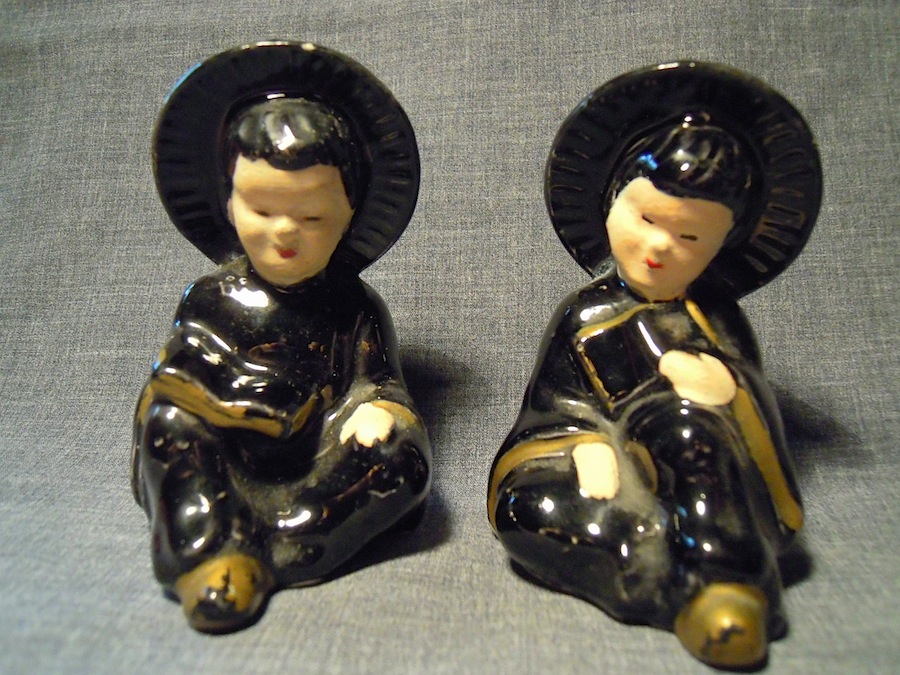
Just to confirm how typically and conventionally stereotypical the set I described in my last post is, here’s a second set that repeats the same basic characteristics:  slanty-eyed Asians of uncertain gender, both dressed in exotic pantsuits, both wearing strange round hats, both sitting on the floor, both engaged in the acts of sensitive aesthetes–this time, both reading and with dreamy, contemplative looks on their faces.  So here, and in the shaker set of my last post, and in the wall plaques of my childhood that I also described in that post, the seated figure inactively and nonviolently in pursuit of the arts becomes an icon of Asian-ness–the Asian as a sensitive soul, a delicate flower, and essentially emasculated, at least as mainstream North American midcult understands masculinity.   The essence of Orientalism transformed into collectable home decor.

Exotic and Smashable Fragility

I’ve previously written a number of posts about the racial stereotypes represented in my salt and pepper shaker collection: lazy Mexicans, but especially adorable Native North Americans and jolly overweight African Americans. This time, it’s the turn of the Asians.

This set sums up one significant branch of the Asian world as it is depicted in salt and pepper sets: the sensitive aesthete stereotype (the other main branch has to do with cooking, especially Chinese cooking–more of that in a later post).  This is one of two similar sets I own that depicts a couple seated on the ground as they play their artistic trades–here, playing a stringed instrument and just plain reading.   I’ll talk about the second set in my next post.

The main effect of these figures is to confirm a kind of exotic vision of the mysterious East–a place where people with eyes so totally slanty that they look like nothing but thin slanty lines, and with strange but luridly bright clothing and truly weird hats, sit on the floor, of all unusual and uncultured places, as they lazily avoid the world of commerce and war in the midst of a dream of fragile beauty.  It’s an ultimate expression of the Orientalism that Edward Said talks about in his book of that name:  the East as the opposite of everything that makes the West and we supposedly inherently superior Westerners powerful and with a divine right to our power; the East as weak, as fragile, as driven by emotion rather than reason, as unworldly and impractical, as childlike, as effeminate if not inherently feminine.  Is possible that these figures represent a male and a female, but both are equally delicately boned and slender and unlikely to be seen partaking in UFC matches or screaming “Yeehaw!” at a Rodeo somewhere manly and tough.  Or making trades on Wall Street, or occupying the Oval Office.

The two are something like ceramic versions of Madame Butterfly or Liu of Turandot–creatures too delicate and exotic to invite anything but being admired in a condescending way that focuses on their ethereal abnormalcy.  They actually appear to be too delicate and exotic to be anything but tragically tormented and heart-throbbingly crushed by the harsh realities of real life.  Their exotic delicacy, I think, evokes a rather ugly kind of sadism–something like a common response to the cuteness of children, a focus on their fragility that more or less assumes their breakability, and that seems in some insidious way to to be inviting an act of breakage.  I can say, however, that I have not yet broken them.  Not yet.  But they so seem to exude a tempting invitation to get on with it and enjoy the resulting self-pity and guilt and remorse.  They are made of some kind of ceramic ware–eminently breakable.  But they are a tough kind of ceramic ware–unlikely to be really hurt by being dropped.  You can toy with abusing them quite safely, then–enjoy the implication of causing them pain without actually indulging in it  (An intriguing sort of parallel, then, to how Robin Bernstein reads the scriptive actions implied by the physical qualities of material objects depicting African Americans in her book Racial Innocence, which I discussed in earlier posts).

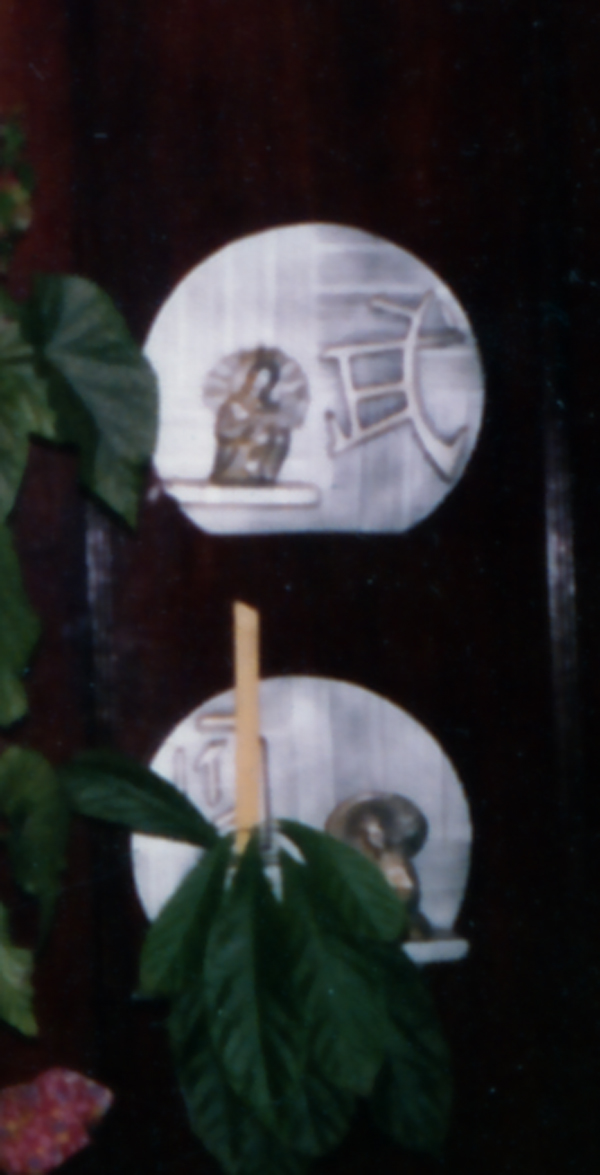
That these shakers fit into a readily recognizable category of mainstream North American kitsch is made clear for me personally by the ways in which they evoke for me a memory of my childhood.  When I was young, my parents owned  a pair of plaques that depicted a pair of very similar figures.  While I have no pictures of them as they once hung on the living room walls of my youth, I do have one shot of them, still hanging on the walls of the house my parents lived in in their later years.

They’re a little hard to see here, hidden as they are by part of my father’s rather immense collection of houseplants.  But there they are, to the right of the photo, one hidden by some leaves.

The figures are seated on the ground, under umbrellas, reading.  I have no idea what, if anything, the symbols beside them mean–although they do sort of look like Japanese letters.  These plaques were originally, as far as I can recall, primarily, black, with gold highlights; my father, who had something of a fetish for house paint and a lifelong urge to paint each and everything that came anywhere close to him (even, sometimes his children as he was busy painting other things), painted them silver as they appear in these pictures.

I have no idea why my parents were attracted by these plaques–or if they even were attracted by them.  They were things they owned in the category of stuff to hang on the wall; and whenever we moved, down they came from one wall and up they went on a new wall in another house.  No one ever really looked at them–they were not artistic objects so much as they were merely acceptable house decoration, the kind of thing you might expect to find on a standard living room wall in North America in the forties and fifties and into the sixties and therefore merely a category filler, not something that invited an admiring or critical gaze. So it really wasn’t until I’d left home and been living elsewhere for some years that I came back and actually noticed what they were, and found myself astonished by the casual taken-for-granted racism of their stereotypes.  My parents were so blind to that racism that they kept the plaques hanging on their wall even after they acquired an Asian daughter-in-law they adored and then two half-Asian grandchildren.  These images of a decidedly mainstream and widely acceptable Orientalism were, it seems, so distant from their experiences of real people that I doubt they ever even made the connection.

Perfectly Armless

Some months ago, I did a series of posts about shaker sets that represent women with various limbs, etc., missing.  I described this set:

The Feminine Ideal?

And this set:

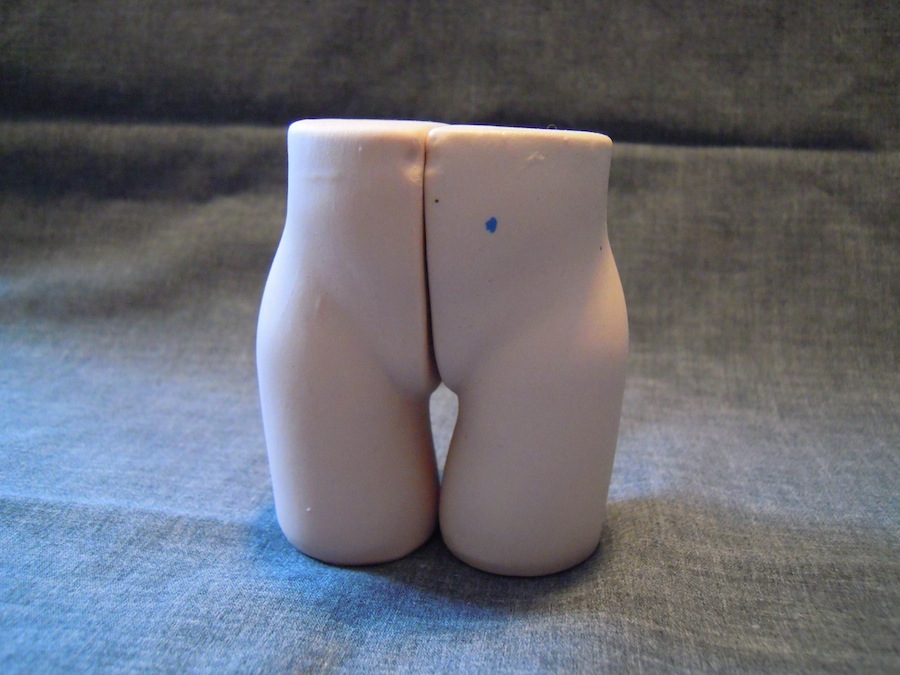
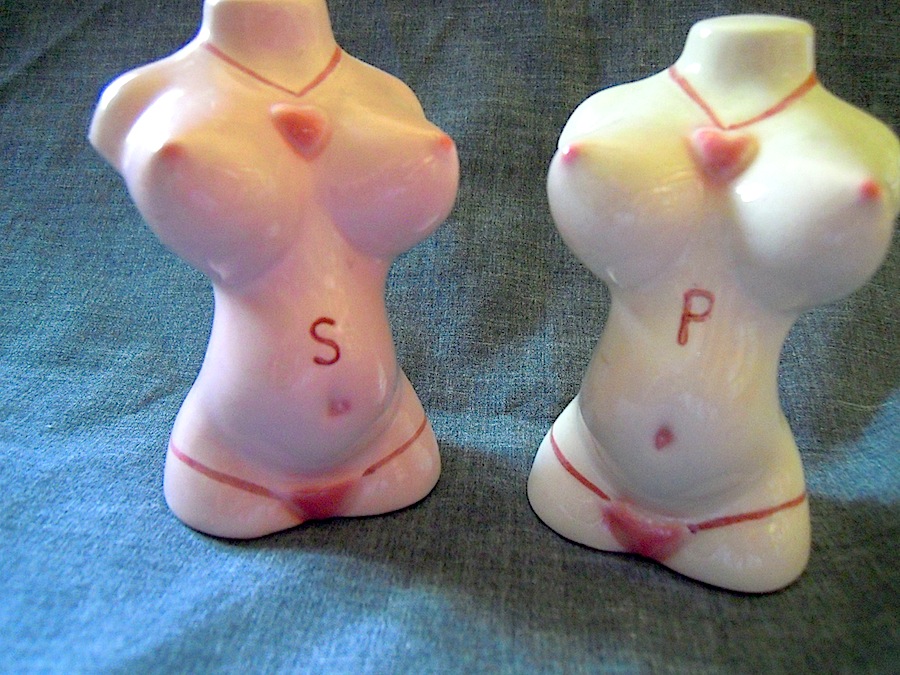
But I somehow managed to forget about this set:

Here we have two more versions of what appears to be a certain sort of masculine ideal of womanhood: no mouth-equipped head to yammer away at you on and on day and night, yadda yadda yadda.  No arms to hit you with for no reason whatsoever at all.  No legs to walk (or run) away from you with.  Just the essential equipment to be a sexy doormat.  But with, of course, that essential sexy equipment in spectacular supply: ginormous boobs.  And despite their thrusting ginormity being so spectacularly on display, a little bit of modesty about the other sexy parts–something a little ladylike, a little valentine-y–as the matching pink heart necklaces also imply.  This is all about love, see, not just sheer rutting lust at all.

There’s something sort of evocative of the Venus de Milo here–a depiction of female torsos without arms.  It’s deeply peculiar that the accidental loss of arms on ancient statues like that one seems to have mandated the production of armless images of women like these shakers as a form of art, and evocative of artiness.  There is, of course, nothing the least bit arty or artful about these shakers–but their lack of limbs does somehow evoke the seriousness and solemnity of a museum, in a way that justifies or allows for the crude randiness they are actually in the business of evoking.

Being receptacles of differing condiments, salt and pepper, it’s not surprising that these two ladies should each be of a different skin tone.  what is surprising is that the skin tones in question should be white and, well, whiter.  Once more, as I suggested in earlier posts about shakers and skin colour, there is no representation of “white” skin in the same set as a depiction of “black” skin–of European pigmentation as opposed to and in conjunction with African pigmentation.  The world of salt and pepper sets remains more or less completely segregated in terms of race.  The offensive racist stereotypes remain in one sort of set, quite isolated from the offensive female stereotypes in sets like this one.

Skin or Mask?

20120830-093136.jpg
Here is another example of a set of shakers that exudes an intriguing ambiguity. It represents a clown, clearly, accompanied by a drum. Why a drum? I have no idea. Perhaps the drum originally came from a different shaker set–although the color tones do suggest these two do belong together. But that’s not the source of the ambiguity. The source of the ambiguity is the clown’s face.

It’s a clown in blackface. Or, wait, maybe it just a clown of African descent, depicted without his makeup. Perhaps he hasn’t put his makeup on yet and he will soon appear under the big top in whiteface–after all, he seems to have grey hair, and surely fully dressed clowns would never wear grey wigs, so that there is still another wig to come. Or, wait, maybe it’s a clown of African descent who has already put his makeup on,and his makeup is a sort of blackface on top of his real pigmented skin.

One way or the other, the face is a version of the one anyone familiar with salt-and-pepper depictions of African Americans will have learned to expect: the fat, bright pink lips dominate–although the equally pink nose does seem to be a more definite indication of a clown face (unless it’s an alcoholic African American with the stereotypical very shiny nose). Since similar faces are found on shakers that do not represent clowns, it might well be just a stereotypical attempt to depict an actual African-American. But since this one does represent a clown, it might just be an attempt in makeup to create an artificial version of that stereotype. It might be a white guy in blackface. And the odd fact that it might just as easily be either of these two quite different things is the essence of its ambiguity. Not the raw and the cooked exactly,but the real and the imitation for sure. The ambiguity is intriguingly revealing of the phoniness and inaccuracy of the stereotype. Even when it isn’t attached to the idea of clowning, the stereotype is essentially a sort of clowning, an imposition of masquerade which, as in the case of the Aunt Jemima and Uncle Mose shakers I discussed in an earlier post, purports to represent reality in a way that seriously diminishes it.

More on Veggie People

Copacetically, just after I’ve just been talking in my last post about salt-and-pepper radishes humanized with human eyes, another blog that is also focused on salt and pepper shakers offers a recent newspaper article about “veggie people”–anthropomorphic depictions of humanized vegetables from a century ago, found on cards and other places, including,eventually, salt and pepper sets. The blog post, from Pinch, Shake, and Grind: Adventures in Salt and Pepper Shaker Collecting, can be found here:

http://saltandpeppershakers.wordpress.com/

The blog is produced by “the world’s only salt and pepper shaker museum,” located in Gatlinburg, TN:

http://www.thesaltandpeppershakermuseum.com/Home.aspx

And this is the newspaper article:

20120825-103634.jpg

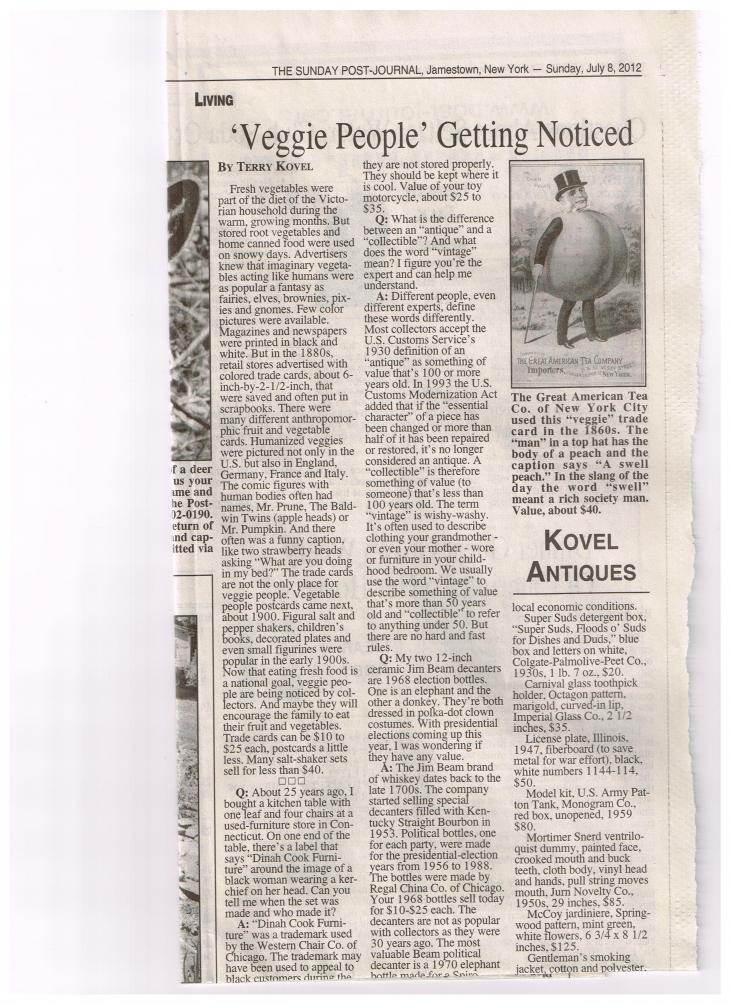
Since I began writing this blog, I’ve become aware of how difficult it is to get much sense of the history of novelty salt and pepper shakers–who had the idea of producing them, when, and why. I know shakers like the ones in my collection were imported from Japan and other Asian nations around the middle of the last century–but that’s about all I know: I can’t seem to find much in the way of books about this industry, its foundation, its artists and idea people, its markets, etc. So I’m pleased to learn a little bit about at least the prehistory of novelty shakers from this article. My thanks to the Salt and Pepper Shaker Museum for finding it and posting it. I just might have to make my way down to Gatlinburg some day to see what there is to see there. and, I suppose, to be seen by any anthropomorphic radish or peach shakers that might happen to be housed there.

Big Radish Is Watching You

If, as I discussed my last post, there’s something odd and unsettling about shalt-and-pepper shakers that look like raw potatoes and that are designed to be put on tables that include cooked food like fries, then what are we to make of a pair like this:

Now admittedly, these radishes (I think they are radishes–either that or carrots that have been out in the sun too much) represent a type of food that it is acceptable to have on a dining table in their raw state–salad vegetables and crudités and the like. So they don’t represent the category confusion between cooked food and raw ones. They do, though, like the hamburgers of my second-last post, represent the confusion between real things and artificial ones. They might appear on the occasional dining table along with some real radishes, thus raising the big question I have been exploring in these last few posts: why? Why fake representations of food to be mixed in with real ones? Why fictional food in a context of nonfiction?

More significantly, though, these radish shakers exaggerate the category confusion (or, perhaps, reveal the underlying ugly truth beneath it) in providing the radish with eyes. Thus humanized, they represent live things in an unliving form, but live things with, apparently, the character and emotions of people–radishes that can laugh or cry, then, or shriek if someone bites into them. While unreal representations, they are a reminder of the fact that real radishes are, really, alive. They may not actually have eyes, but they could still be emitting some sort of soundless vegetable scream as you pull them from the ground.

A strange thing to want to be reminded of at the dining table as you sit down to begin the process of ingesting living or formerly living things. What if your pot roast or your pork chop were actually staring at you also with big cute eyes? There’s a long tradition of inanimate objects humanized, in Hans Christian Andersen stories like “The Steadfast Tin Soldier” and old Looney Tunes movie cartoons and children’s books (The Brave Little Toaster, e.g.,) and places like that, and I have to say I always find it a little unsettling. But placing such a humanized, representationally sentient object on a table amidst a number of similar objects one is about to ingest seems downright peculiar–something like saying mass for the pig just before you smack your lips and eat the pork chop.

Le cru et le cuit

In my last post I talked about how categories get confused when you put salt-and-pepper shakers representing food items on a table in the midst of real food items: categories like real and fake, hard and soft, edible and inedible, etc. Yet another such category, one that the anthropologist Claude Lévi-Strauss thought was culture-defining, is le cru et le cuit: the raw and the coked.  For Lévi-Strauss, “cooked,” refers to anything that is socialized from its natural state–rawness. All societies have binary structures that distinguish between the raw and the cooked, the fresh and the rotten, the moist and the dry or burned, but they separate them differently.  And the separations are, he claimed, always important.

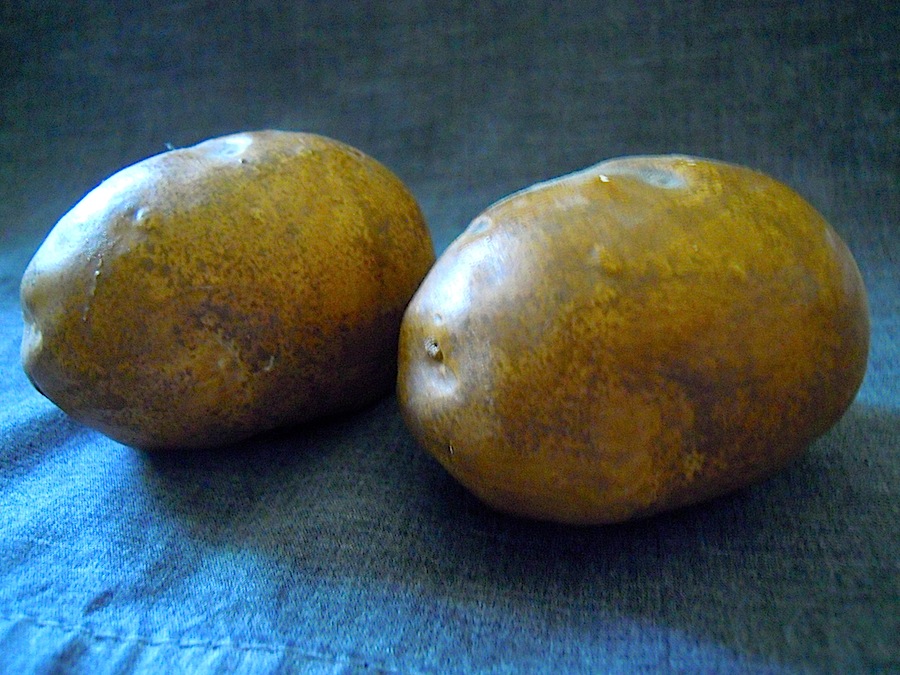
So what about salt-and-peppers representing raw food?  Not that the salt-and-pepper versions of food are either raw and cooked (unless you consider doing time in a kiln to be cooking).  But some of them are, in fact, clearly meant to represent something that is raw.  Like these, for instance:

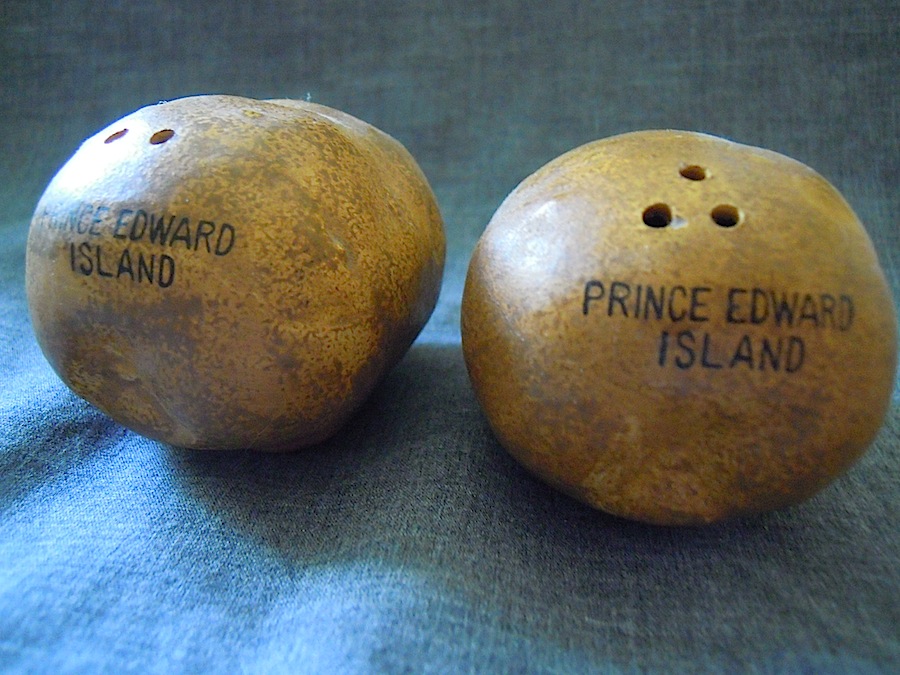
Raw potatoes, right?  Very clean raw potatoes, very shiny ones–but still raw.  And unlike the mini-hamburgers of my last post, these potatoes are actually large enough to be considered life-size.  They look surprisingly like the things they represent–might actually, for a moment or two, trick someone into believing they were real, until a closer second glance might reveal the truth implied by the presence of holes for releasing salt or pepper and, also, the imprint of the place they come from:

But why would you want fake raw potatoes on the dining table?  Raw potatoes are what exists before you prepare the fries or mash or Pommes Anna you might also have on the same table.  You would never have real raw potatoes on the table–so why imagined ones?  a reminder of where the fried came from, what they once were before they were turned into fries?  A reminder of rawness amidst the pleasures of cookery?  Who needs reminding, and why?  These shakers are, strangely, disconcerting, though, even if I don’t know exactly why.  There’s something playful about placing imagery of raw food in the midst of real food–playful in an impish and unsettling way.  Culture-disturbing, somehow.  Anti-social.

Food, Fictional and Non-Fictional

Thinking as I wrote my last post about how disturbing it was to look at versions of the exact same characters in different poses in two different salt and pepper shaker sets, about how the impression that they could move and take different positions seemed to suggest a life they were leading outside and beyond their hard ceramic shaker-set lives, and how suggesting that seemed to break the contract they imply about being safely shakable because they are hard, are ceramic, are not really the things they represent, not really alive, not really all that damageable, I became aware of another oddity: salt and pepper shaker sets that represent food.  Like these:

I mean, think about it for a moment or two.  You are serving a real meal consisting of real food–food you can eat.  Like maybe a hamburger, even.  And yet, there on the table is a hard, ceramic, entirely inedible object that represent something edible.  Like maybe a hamburger, even.  I get that there’s an obvious connection between salt-and-pepper shakers and food, that they are implements to be used in the process of serving and eating food.  And I suspect it’s for that reason that I have so many shaker sets that represent food, from carrots to bananas to milk and cookies But for all the logic of that, it still seems more than a little strange that you’d want representations of food on the table where you are serving real food.  It’s a weird confusions of categories:  real and fake, hard and soft, edible and inedible, etc.  It seems inevitably to raise the question of just how representative these objects are–how they are fictional food with their fictionality made obvious by their presence in the midst of non-fictional food.  Why put things that look like food but that you can’t eat on the table along with the actual food?  Is it the creation of some sort of puzzle–figure out what you’re supposed to put in your mouth and what you’re supposed to keep out of it?

Beyond that, I’m not quite sure about what to make of the act of shaking a fake hamburger over a real hamburger in order to get salt and pepper on it.  Or for that matter, shaking a fake hamburger over a vegetarian meal of beans and rice to get salt and pepper on it.  For there is a sort of actual food being provided by the shakers–the salt and pepper that you will shake on the real food and then eat.  They are not food but they can make the food taste better–just give them a shake and, perhaps, some of their magical unreal pretending will fall into the real food and make it more magical?  Are these shakers some sort of strange transitional object, then, not quite real and not entirely pretend?

One other aspect of these hamburger shakers also freaks me out a little: their shininess.  They are surprisingly lifelike, except for that shininess.  They look like real hamburgers, albeit miniature ones, that have been shellacked or varnished.  Hamburger preserved for posterity, perhaps, or in their sparkling shininess, the purified essence of hamburgitude, smaller than but better than the real things they represent.  Perhaps, then, they share the diminishing utopianism of all miniatures, all dolls and dollhouses and such: more perfect but infinitely smaller, infinitely more cramped, and more easily managed worlds than the real one.  Having a miniaturized and therefore both cuter and more controllable hamburger on your table along with the real ones–is it a sort of fetish object, a representation of the wish that the real hamburgers be just as safe and in control as the fake one, just as free from taint and bacteria and deathly additives and all the other potential harmful aspects of actual meat?