Once More for Old Times’ Sake, Once More

When I wrote about shaking in my last post, I realize, I was taking something important for granted:  you are allowed to give the shakers a symbolic shaking that implies violence to the person or thing a shaker represents because the shaker is, in fact, merely a representation–not actually the thing it represents, but a merely an image or replication of it, and so tough enough, hard enough, to take it.  You most likely wouldn’t feel right about giving a living naked woman or a real-life African-American pancake cook a good shake–it might actually hurt them.  Also, furthermore, they might retaliate and give you a good shaking right back, or maybe the swift uppercut to the jaw that you deserve.  But the violence towards unsettling Others that you are likely to veil and hold back in real life is allowable against a mere hunk of earthenware.  You can shake the bejeezus out of a shaker-set depiction of a cute aboriginal child without any consequences whatsoever, except possibly the sprinkling of too much salt on your dinner and, eventually over the long term, perhaps, a well-deserved heart attack.

At any rate, it’s in the context of that allowable violence that this particular salt-and-pepper set particularly startled me:

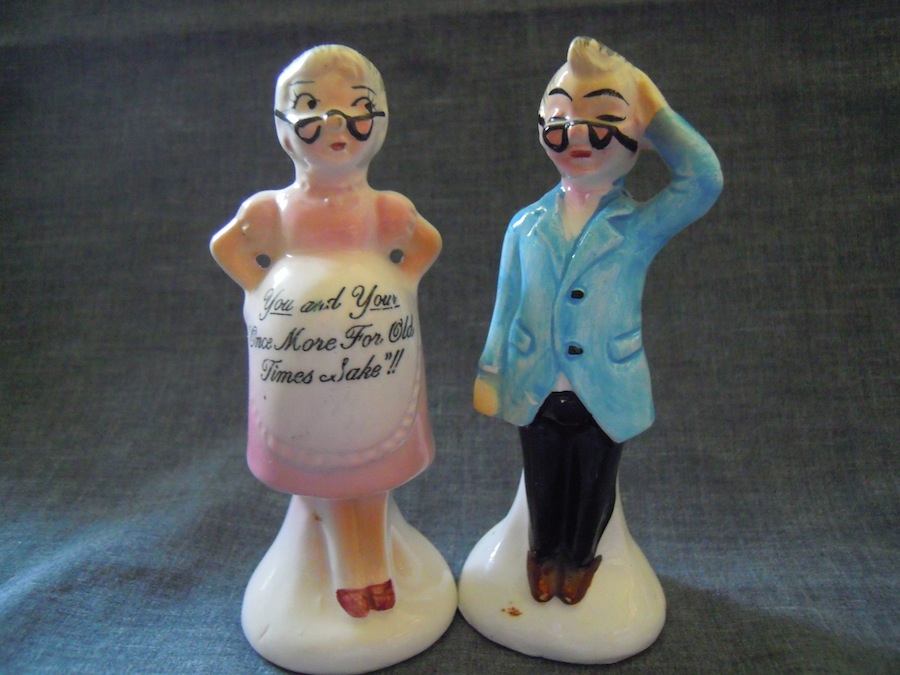
In itself, nothing all that startling; but some readers of this post might recall an earlier post in which I discussed another disconcertingly similar shaker set, one that looked like this:

So it’s the same couple, apparently–but in this earlier shaker set they’re standing, and in the new one I just purchased recently they’re sitting down.

How is that possible?

I suppose there’s some technical explanation about reshaping an old mould or something like that.  but when I first saw that sitting couple after already being familiar with the standing one, it really did startle me: how could figures in hard ceramic be captured in different positions?  Somehow, it seemed, the old man and the old lady being represented had actually moved–or at least ,were capable of movement.  They could stand up and they could, apparently, also sit down.

And if they could do that, could they be so safely and harmlessly shaken after all?  Were they merely representations, or, somehow, more alive than that?  Was their tough ability to take it merely a pretence after all?

It helps to some degree to realize that, while they look almost exactly the same, have the same glasses, the same clothes, the same facial expressions and so on, these couples are actually two completely different sets–not the same set in a different moment, but two similar sets in the same moment, as here;

Still, if these people can both stand and sit down, might they not also give birth?  Can I expect to find yet another set of the same couple, she in the agony of labour pains, he with both of his hands over his ears instead of just one hand over one ear?  There’s something all too Frankenstein-ish about these pairs.  They’re alive!  They’re alive!  They’re alive!  I’d like to give them all a good shaking.

Shaking

In my explorations of the scriptive actions of salt and pepper shakers over the past while, I’ve considered everything but the most obvious action they imply–the one implied by their name: shaking.  Salt and pepper shakers are made to be shaken.  Furthermore, as I think about it, I see that the act of shaking is the one that might be most productive of insights in terms of how Robin Bernstein herself explores the concept of scriptive things that she develops in her book Radical Innocence.  Salt and pepper shakers are made to be shaken, i.e., to be treated with a certain amount of violence: you aren’t going to be getting all that much of the salt and pepper you’re hoping for from shakers so fragile that the action of shaking might break them. And while most of  the novelty salt and pepper shakers in my collection are made of some kind of potentially breakable earthenware, it’s a very durable, not-really-all-that-easily breakable kind. Most of my shakers are pretty old by now, probably from the fifties or sixties, but most of them are intact, the few exceptions being the occasional dog or cat’s tail or canoe paddle or other small projecting part that’s been broken off.  I’ve dropped a few of them from fairly substantial heights, with no apparent damage.  They are tough.  They can take it. They invite being shaken. Shaking them makes food taste better.

All of that develops other resonances when we consider what the shakers represent.  Here we are, in a world full of adorable, cute, petite little doggies and humanized carrots and aboriginal children, and what are we being asked to do to them?  Shake them–that’s what.  We are being invited to give all these theoretically adorable things a darn good shaking, an act that will make our food more enjoyable.  So why would we want to shake the things we find so adorable?  Why would anyone want to shake these doggies, for instance?

They are so gosh-darned, all-fired cute.  They simper or respond to simpering.  They have weirdly human-looking, eminently batable eyelashes.  And yet there appears to be an invitation to the expression of a probably otherwise unacknowledged hostility towards them–perhaps the same hostility that might be inherent in the act of perceiving someone or something as cute, a need to give the object less power over us than its adorability might appear to be demanding.

In fact, I can’t deny an urge to give these particular poodles a good shake.  They are so busy inviting my cooing response to their adorability that I find myself loathing them.  Shaking is what they deserve.  A whole lot of shaking. Shaking all over.

They poodle shakers are clearly less dangerous and more dismissably harmless than actual poodles, a further diminishing of the inherent wolfness that gets constrained in the very existence of poodles.  If you shake a cute little poodle, you are adding a layer of implied physical violence to the violence against the threatening nature of animals that the cuteness of the shakers being shaken already implies.  The major emotional or psychological purpose of novelty shakers depicting cute things, as I’ve suggested in a number  of earlier posts, is to minimize and constrain and imply control over what we must otherwise find to be threatening.  Shaking such already minimized objects just seems to add more intensity to the minimization and control.  We are being invited, it seems, to buy and make use specifically of shakers that represent particular things we do feel threatened by–by, say, the bodies of women (see earlier posts on breasts and amputees), or animals and animality generally (in regard to shakers depicting lions or cats or lobsters or poodles) or by “savages” (the cute aboriginals) or other people of colour (Aunt Jemima).  Shaking of shakers is inevitable.  Violence against the object they depict is, it seems, mandated and allowable–and often, for a lot of us, I suspect, very, very satisfying.

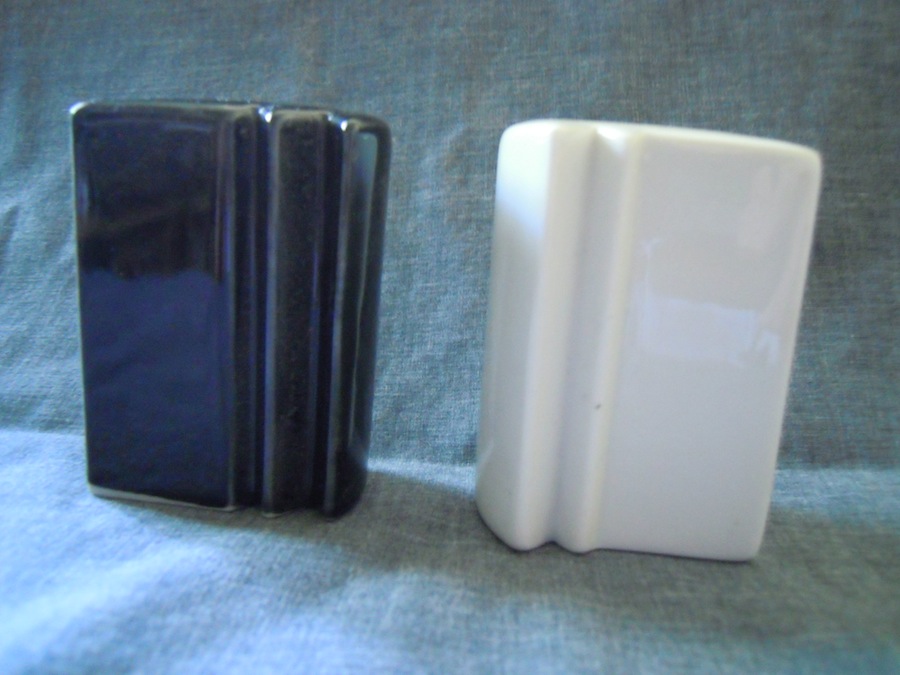
Just how satisfying might be revealed by this set of shakers I own:

At first glance, they might seem kind of boring–a pair of plastic shakers in the shape of traditional old-fashioned glass shakers, each in in the colour of the seasoning that might be found in such an old-fashioned set: black and white.  But that little loop visible on the white one reveals their secret:

Those are loops attached to pull strings, and when you pull the loops out from the shakers, the shakers begin to shake all by themselves, as is visible in this video.  The thing is, watching them shake all by themselves is no fun.  No fun at all.  And furthermore, letting them shake all by themselves puts no salt and no pepper on anybody’s food.  They are both fairly boring and completely useless, in ways that reveal the deep ugly secret hidden at the heart of more conventional shakers:  shaking, the sheer energetic, violent, satisfying act of shaking, is what they are all about.

Shit, Kitsch, and Other Things that Stink

In my last post, I suggested that one of the actions scripted by novelty salt and pepper shakers is conversing about them as artistic objects: the invitation to “observe them more closely–perhaps in something like the way we look at paintings or other art objects, with an eye to understanding both what they represent and the possible implications of the ways they represent it.”  I’d just like to qualify that comment a little, for it’s clear that while these shakers operate as something “like” art, the response they seem to invite is not the same as the ones invited by, say, a conventional portrait or landscape painting or an abstract presentation of non-representational forms and colours. There’s something about their littleness and their cuteness that’s asking for something different from more standard forms of aesthetic observation and openness to being affected by what one views aesthetically.

That something different seems to be an awareness of how small and how harmless the shakers are, how unlikely they are to actually produce deeply involved or emotive responses. Ion other words, they’re inviting a kind of safe simulation of aestheticism, an indulgence in the act of opening oneself up to the potential of art  to affect one, but within a safely narrow range of possibilities: you know when you choose to look at a novelty salt and pepper shaker as an object of aesthetic contemplation that it’s not going to alarm you in its potential to make you think new thoughts or to change your life forever.

In this way, I suspect, novelty shakers represent the kind of art (or non-art?) that the Czech novelist Milan Kundera calls, in The Unbearable Lightness of Being, kitsch:  Talking about an acknowledgement of defecation and its products as an acceptance of the human condition as it is, Kundera says that not acknowledging such things in a claim to see nothing but goodness in the world is a form of agreement with the way things are that actually denies them:

It follows, then, that the aesthetic ideal of the categorical agreement with being is a world in which shit is denied and everyone acts as though it did not exist. This aesthetic ideal is called kitsch… Kitsch is the absolute denial of shit, in both the literal and the figurative senses of the word; kitsch excludes everything from its purview which is essentially unacceptable to human existence.

Denying shit–or perhaps, preferring and willing oneself not to be aware of it–is an insistence on a sort of perversely inhuman utopia–a place imagined as ideal because it is not connected with bodily functions and their implications of mortality.  Kitsch represents a denial of what the character Crazy Jane in a poem by William Butler Yeats once exuberantly proclaimed:

‘Fair and foul are near of kin,
And fair needs foul,’ I cried.
‘My friends are gone, but that’s a truth
Nor grave nor bed denied,
Learned in bodily lowliness
And in the heart’s pride.

‘A woman can be proud and stiff
When on love intent;
But Love has pitched his mansion in
The place of excrement;
For nothing can be sole or whole
That has not been rent.’

Viewed as this sort of kitsch, novelty shakers not only deny the existence of shit and the place of excrement in their safely miniatured cuteness and ceramic hardness. They also actively proclaim the importance of not paying attention to shit–of immersing oneself in the cutely miniature as a sort of safely diminished and relatively passionless diminution of a more complex reality as it actually is–a way of denying or perhaps more likely, conscientiously ignoring, the painful or pleasurable limitations of the human condition by replacing it with something less disconcerting.  In this enclosed and safely lifeless world, even skunks don’t smell, and are safely enjoyable as just plain cute:

With their clearly visible and normatively conventional gender distinctions (one wears lipstick, the other carries what appears to be a phallic green carrot) these googly-eyed creatures are hardly even animal at all; both have a pink blush on what surely must be their fur cheeks.  Blushing fur?  Really?  Diminished and de-shitted and made less alienly animal and more like us, these skunks represent an apparently safe escape from what we actually know to be a more complex and shittier and stinkier world, and therefore, they offer a not-so-safely disinfected world after all, but instead, an invitation to a life-denying willed blindness to the messier way and stinkier things actually  are.

Not suprisingly, Kundera goers on to read totalitarian political implications into kitsch, calling it totalitarian:

But whenever a single political movement corners power, we find ourselves in the realm of totalitarian kitsch. When I say “totalitarian,” what I mean is that everything that infringes on kitsch must be banished for life: every display of individualism (because a deviation from the collective is a spit in the eye of the smiling brotherhood); every doubt (be-cause anyone who starts doubting details will end by doubting life itself); all irony (because in the realm of kitsch everything must be taken quite seriously).

In the worlds of kitsch and novelty salt and pepper shakers, “all answers are given in advance and preclude any questions.”  In that way, in fact, the shakers really don’t invite the intense gaze of works of art; they invite merely the kind of quick glance that notes a comforting cuteness and familiar recognizability and then, satisfied by the confirmation of painlessness, slides off and away from details.  They offer, in other words, an invitation to not look too closely, to look without seeing too much.  The kinds of close looks I give to the shaker sets I’m describing in this blog are not, in fact, scriptive actions they invite.  I’m noticing too much, in too much detail, to preserve my complacent semi-blind and blinding appreciation of them.  Seeing them as totalitarian kitsch is to deny the efficacy of their totalitarianism and their kitschiness.

Scriptive Things, Fifth Verse: A Little Bit Louder, A Little Bit Diverse

The question remains the same.  Generally speaking, what actions or responses do novelty salt and pepper shakers invite when they appear as part of a table setting for a meal?  Most obviously of course, they invite those at the table to shake them, i.e., to put salt and/or pepper on their food–and whatever kind of shakers they are, plain or fancy, they bring with them the range of  implications and invite something like the kinds of responses I’ve tried to outline in my last few posts.  But in addition to all that, their novelty aspects add yet more nuances.  In order to explore those in as non-specific a way as possible, I’ve chosen a set of shakers that are even less distinct or unusual than the pair of bear of my last post.  This time it’s pigs:
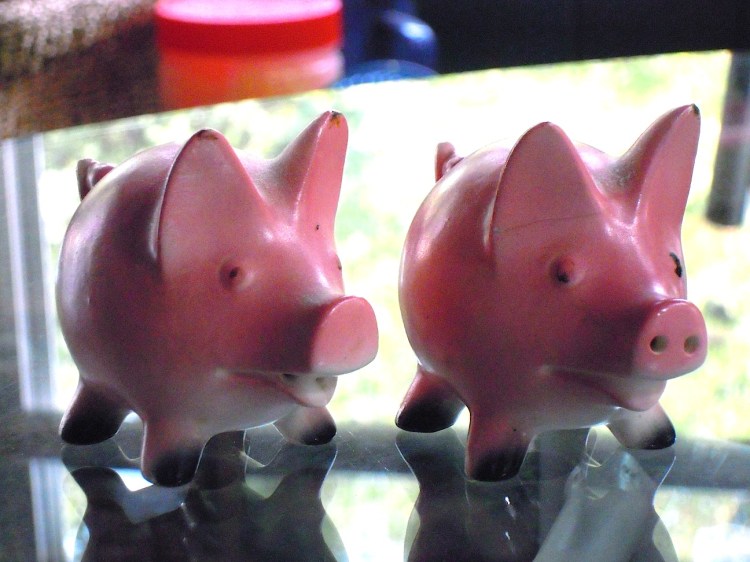
These two are one of the few sets I own that are actually carbon copies of each other–exact duplicates, except for the fact that one has two holes (for salt, I’m guessing) in its snout, and the other has three holes in its mouth (for peppers, since I understand that the one with more holes is usually understand as supposed to be the pepper).  They’re just a pair of simply formed and mostly pink pig shapes–a vaguely cute evocation of pigginess, with a bit of cleverness in the placing of the holes in the snout where the snout holes would be in one instance and in the teeth where gaps would be in the other.  but still, you wouldn’t want a real pig on your dining table.  Why these, or things like these more generally?

Most obviously, I think, they evoke a kind of lightheartedness, or whimsy, a sense that this is a relatively informal and congenial kind of table to be dining at.  They convey the idea that the person who chose to put these on the table doesn’t take things too seriously, likes to have fun.  in that way, too, they reveal a personal taste.  In doing so, clearly, the action they most clearly script (beyond the action of salting and peppering one’s food) is a response to that perosnal taste, ideally, of course, a positive one, like, “My, how adorable,” or “What cute pigs.”

In other words,  they exist significantly as potential topics of conversation–things to comment on.  And the more novel they are, the weirder or more sexy or more bizarre they are, the more they invite a conversation about their uniqueness or novelty.   They exist, to a great extent, primarily to be noted and commented upon.   And the fact that someone chooses to make something so novel or noteworthy a part of the dining experience  makes them markers of a unique or novel selfhood.  They ask us to think positively about the specialness of the person who chose them: “Ooh, what adorable little pigs, Samantha.  You have such good taste.”  Or “Where did you find these pigs, you clever thing?”  Or “Pigs?  Really?  Is it one of your clever little jokes, Sam?  Because I do plan to pig out on that pot roast–it smells divine.”

All of that leads to what I suspect is the primary action encrypted in the existence of purchases like this–an urge to desire them and, when they appear in stores or garage sales or on eBay, to want to purchase them and have them for one’s own.  As more or less impractical novelties that defy the important design principal of less is more and exude more whimsy than utilitarian practicality, they script an invitation to ownership, to possess them for their cuteness and their novelty.

And apparently, given my two hundred or so sets, they seem to script that urge to possession in terms of multiples.  One set of novelty shakers, obviously, cannot in and for itself imply a desire for a larger number of others to go along with it.   But I think that the fact of their coming in such a range of different shapes and sizes and representations of different animals, people, and things does imply an urge to moreness–to having more than just one set of shakers, and indeed, more than just twenty or two hundred.  There are pictures showing surprisingly large collections of them all over the internet–collections of many thousands arranged in voluminous crowds.

So what it is about them that makes them so eminently collectible?  How do they script collectibility?

One, they are relatively expensive–you can usually always afford to get yourself a few more without going into serious debt. So why not go out and get more, right now?

Two, they are small, and you can have a surprisingly large number of them in a surprisingly small place.  Indeed, they are small enough that you can almost always manage to squeeze a few more into the same shelf space, where they end up looking like the Tokyo subway in rush hour .

Three, they represent things–a variety of things, thus encouraging those who have some shakers that represent some things to want other shakers that represent other things

Three, they all basically do the same thing–contain and distribute salt and pepper–and thus,  they are very much alike each other in general shape and size and conformation; and yet at the same time, in their act of representation, they can be surprisingly different from each other.  In other words, they are the same sort of object but with clearly obvious (or sometimes even not so obvious) differences from each other–a combination of sameness and difference that allows a collector to focus on just the one kind of object (“I only collect salt and pepper shakers” or even “I only collect salt and paper shakers that represents pigs”) but to keep adding different individual objects to the general category in order to represent the scope of the category more completely. Like stamps or coins or Tiffany lamps, shaker sets represent an ongoing and therefore eminently collectible series of variations on each other.

As collectibles, the action novelty shakers more urgently encsript is putting them on display in groups and inviting other people to look at them, first as a group (“You have so many!”) and then, once having a first impression of admirable bulk and mutititudinousness, to pick out ones that appear specially interesting and observe them more closely–perhaps in something like the way we look at paintings or other art objects, with an eye to understanding both what they represent and the possible implications of the ways they represent it.  in other words, once more, they script discussions of themselves and their interesting novelty.

How the discussion goes can obviously be various.  Most of the members of the Novelty Salt and Pepper Shaker Club seem, as the club’s web site suggests, be motivated by a pure and unmediated  “love of collecting novelty and figural salt and pepper shakers,” for, it seems their own sake, as intended. As I’ve suggested in earlier posts, though, my own interest tends to have more to do with a kind of mean-spirited feeling of superiority to many of the shakers I own–an ironic enjoyment of just how tasteless and silly and awful they can be.  Even so, I’m not totally convinced  that the shakers themselves don’t actually script at least the potential for that sort of ironic and theoretically disengaged response to them.   Some of my sets are trying very hard to elicit a kind of objection to them–to be offensive or crude or otherwise disruptive of conventional niceness in ways that are meant to be humorous or otherwise pleasing.  Like a range of comedy in greeting cards and night clubs and on T-shirts and coffee mugs, they do often seem to be scripting a supposedly negative response, or at least, a response that confirms the responder’s awareness of their antisocial tendencies and a positive or negative attitude toward them.  They are made to be objected to, or to be perceived as satisfyingly objectionable.

And I also have to acknowledge, as I think about it, that my own ironic and superior response is also often accompanied by a more positive appreciation of the attempt at jocular playfulness that arouses that feeling of superiority.  Their awfulness makes me smile, or even, sometimes, to manipulate them in ways that either help me to express how foul I think they are or reveal even deeper levels of double entendre.  Think, for instance, of what you might tempted to do with a pair of detachable breasts; think of the verbal scripts of pidgin English you might invent as you imagine what some offensively stereotypical Indian shakers might say.  Many novelty shakers are playful and a lot more of them invite playfulness–even the act of actually playing with them, as revealed by the shoebox and larger displays created by contest winners at the Novelty Salt and Pepper Shaker Club convention and depicted on the club’s website.  These are scenes using a number of different shakers that club members create by playing with them and playfully arranging them into groups and in settings–check them out here.

There’s more to be said about how the shakers encourage playfulness, and what sort of interactions that playfulness enscripts–like, for instance, shaking little pigs to put salt on your spuds?  More next time.

Scriptive Novelty: A Pair of Bears

And now, on to what scriptive attitudes and actions might be implied by having a set of novelty salt and pepper shakers on the table. Just so that there’ll be something specific to refer to, I offer what I take to be a pretty basic and therefore really rather uninteresting example of the kind of set I mean–novelty shakers that, unlike depictions of women with removable breasts or dark-skinned miniature people riding Chinese cabbages or combinations of dogs and fireplugs or pins and benches, really aren’t all that very much of a novelty.

This pair of bears are, mostly like each other–clearly a pair because each is so much like the other, and yet clearly a pair also because of some relatively minor differences from each other: one wears a baby blue bandanna, one a baby pink one; one plays a banjo while the other appears to be reaching for a pistol. They go together both because they are alike and because they are different enough to need each other in order to make some kind of point about being the same despite the difference–soul-mates despite superficial differences, the salt-and-pepper version of “we were meant for each other,” maybe? Like humans in love, significantly different people, most conventionally in the traditions of romance one male and one female, who are as one.

It’s no accident , I think, that the bandannas are this particular blue and pink. They make an all-important gender distinction visible by an outward sign of it in a way that seems, most of the time, as necessary in salt-and-pepper sets as it appears to be increasingly in our bringing up of young children. These days, boys in the real world do not, not ever, wear pink. Girls do. Girls always do. And thus even complete strangers know at a glance when they pass a baby on the street what particular formulation of genitalia it possesses. We need to know it, it seems. And we need the babies to know it, too, as soon as they can possibly learn it. And we want our novelty salt-and-pepper bears to display the signs of it, too. I plan in a later post to discuss of number of shaker sets in my collection which distinguish between two otherwise exactly duplicate shakers by providing some small symbol of what then becomes a difference in their genders–a difference that makers them as both different and belonging beside each other.

Why the gender of the figures represented by the salts and peppers on our tabletops matters all that much I do not know. It might have something to do with the comforting nature of most novelty salt-and-pepper sets, the way in which they represent safety. There’s a boy and a girl,which is just the sane, safe, old heteronormative ways things ought to be. This is a table, they seem to announce, the table we sit atop, where convention and good-old-fashioned normalcy reign. No surprises here, no radical upsetting of tradition, no perverse or perplexing or uncomfortably mind-stretching anarchy. You may sit and eat safely and serenely, and not be discomfited or challenged.

Apart from their insistence on the importance of gender, what makes these bears good examples of conventional mainstream “novelty’ as expressed in the salt-and-pepper world is their cuteness. They are kind of smily, kind of round-faced and round-eyed and round-bodied, kind of chubby and anything but dangerous–even though one, the one in pink, of all things, appears to be reaching for her gun, perhaps in response to the quality of the boy bear’s banjo-picking?

Hmmm. Perhaps they are more weird and interesting than at first they appeared to be. Wouldn’t you expect the boy to be the aggressive gun-reacher, the girl the artsy musical one? For that matter, wouldn’t you expect the one identified as a girl to be the one with an object carefully placed in front of what would be her exposed breasts if she were a human girl? There is more going on here than first meets the eye.

Nevertheless, the cuteness seems to matter more than, and to trump, that weirdness–and above all, the danger. So what if these are supposed to be bears, savage conscious-less animals no human beings should ever really want to get too close to? So what if one them appears to be about to pull her gun and take a shot at something, maybe her musical companion, maybe the fragile good china they share a tabletop with. They are cute bears, more like teddy bears than actual living ones. And like teddies, they represent a danger defanged, a danger it’s perfectly safe to get close to and cuddle. The bears represent, once more, in this different way, safety and comfort and ease, a soft-edged haven from the less placid reality away from but always all too near the dinner tables they’ve been designed to sit on.

Furthermore, they are humanized animals, bears wearing human clothing–cowboy hats, chaps, bandannas. And that’s another aspect of their cuteness, their existence as animals who appear to be acting safely like humans, or perhaps humans who appear to be safely dressed up in bear costumes and pretending a very undangerous dangerousness. There’s something about humanized animals that makes them creatures of the margins, the border-defying places between what is usually seen as separate and different. And that somehow diminishes them, makes them both less than animal and less than human, but in ways a lot of people find pleasing and comforting rather than distressing.

Okay, you may be asking, so what happened to scriptiveness? Good question. At this point, I have to acknowledge that I appear to have selected the wrong shaker set to talk about–the oddities of these bears have got me sidetracked from my original plan of talking about what kinds of actions they might be scripting, and what implications those actions might have. I’ve talked about how they look, and how they might be inviting specific understandings of aspects of their appearance that imply cultural attitudes. But I haven’t yet talked about what kinds of actions they might be inviting their users to perform with them. I guess that’ll have to be the subject of my next post.

Binaries as Scriptive Things

Before I head onwards towards a consideration of the novelty aspects of shaker sets as scriptive things, I think there’s one other aspect of salt-and-pepper sets generally that needs to be considered:  their implications as a coupled pair.  The question here is not just, why salt and pepper, but also, why salt and pepper together?  Why the two of them?

The first thing that occurs to me is that their twoness does seem to be invested with significance.  Perhaps it’s just familiarity, but there’s a feeling of rightness about the two always being there, and a sense of there having to be a quite different kind of cultural atmosphere if there were only one of them–if there were conventionally just salt with no pepper or pepper with no salt–or if there were three or four condiments usually available instead of just these two.  As two, they seem to evoke the basic binary opposites that, according to Claude Levi-Strauss, are the primary components of all human thought.  We think of what we experience by dividing what we perceive into binaries: good and bad, rich and poor, male and female, gay and straight, us and them, old and young, etc., etc., etc.: and then we try to find some way of uniting what we have chosen to perceive as divided.  For Levi-Strauss, the myths that sustain cultures are all about the process of juggling such opposites against each other and exploring or insisting upon imaginative ways of trying to move past their opposition.  Salt and pepper shaker sets might well represent that sort of mythic thinking.

They do so, I think, by emphasizing both sameness and difference.  Salt and pepper are both seasonings, but each is a different seasoning.  They serve more or less the same function in relation to food–but do so in terms of different flavours with different implications.  Whatever saltiness is, whatever ideas or emotions it evokes (and there is a wide range of them, from evocations of sad tears to painful wound-rubbing to flavourfulness), it is significantly different from what pepperiness is, and what ideas and emotions it evokes: heat, daring, danger?.  Yet both serve the same function in relation to personalizing food and adding to what its basic and/or cook-established flavours are–both occupy the same categories for all the differences in the ways they do it.

Furthermore, as binaries, they seem to exist most significantly in relationship to each other–as necessary to each other in order both to establish an opposition and to suggest the possibility of the opposition’s resolution, or, perhaps, the completeness that the two together might create as opposed to the insufficiency of just one of them.  They go together like a horse and carriage, or love and marriage–as that old song insists, you can’t have one without the other.  The song is wrong, of course–you can have one without the other.  Indeed, the very fact of their individual separateness from each other makes it possible for them not to come together, to love without marrying or to sprinkle just one condiment on your pork chop and forget about the other altogether.  But even if you choose salt but no pepper or pepper but no salt, the invitation is there to think of them as part of a pair, a pair which give you the freedom to choose both or neither or just one. They imply this script of choice and binary opposition, and it’s the basis of all the jokes and intriguing implications of all the novelty sets:  there’s this thing, and then there’s this thing, and whaddya know, they go together.  Or not.

There is also, I think, a pretty strong insistence in even the most basic of shaker sets of their difference from each other.  In plain old glass shakers you can see through the glass that the one condiment is white and the other is black; in sets that represent nothing animal or human, etc, but are just a pair of two similar-looking containers, there tends to be marking, usually a large S and a large P, the makes the contents crystal clear.

When such shakers appear on a table, they usually represent the only typographical print on the table–unless there happens to be a printed menu, there are no other letters visible but this S and this P.  The appearance of these letters in an otherwise print-free zone emphasizes how significant it is that we realize their difference from each other and their equally important togetherness in the category they share.  It also suggests how significantly symbolic and linguistic their differences are–how they imply a structure of relationship that is the basis of how language generally works.  If looking at a set table might be understood in terms of Jacques Lacan’s version of the Imaginary–what we see as different from who we are while seeing it–then the S and P might represent a move into the Lacanian Symbolic–the oppressive prisonhouse of language in which everything relates to and evokes everything else and insist therefore on claiming to be the way things are and the only way we who have entered into language can understand not only others but ourselves.  S and P on the table–even when the shakers don’t actually say S and P, but imply in their representations a version of that basic difference–is an expression of agreement to being social, enmeshed in a specific civilization and its practices, a move beyond what we see to an entire structure of abstract meanings.

I suppose, in the context of a culture with a history of slavery, segregation and ongoing racial prejudice like the USA, there also has to be some hint of significance of the importance of a black condiment and a white one as the omnipresent accompaniments to mealtime.  In an earlier post, I explored the oddity of there being lots of depictions of African American stereotypes in my extensive collection of shakers, and lots of depictions of what appear to be white people, but only one set that depicts a mixed race couple.  In a comment on that post, Kyla Wazana Tompkins reported her findings, explored in her new book Racial Indigestion: Eating Bodies in the 19th Century, that “racist kitsch is rarely about a black and white figure in some sort of mutual relation, but rather about blackness being consumed.”  But I’m finding myself wondering in the context of American history and culture if racial black-and-whiteness might not be implied in shaker sets even when there is no explicit expression of it–if part of the specifically American script of shakers on American tables might be the expression of attitudes to race that seems to appear in just about every aspect of American culture, and so must, surely, be implied by the conventions of table-setting and dining and the scripts implied by the items conventionally found there?

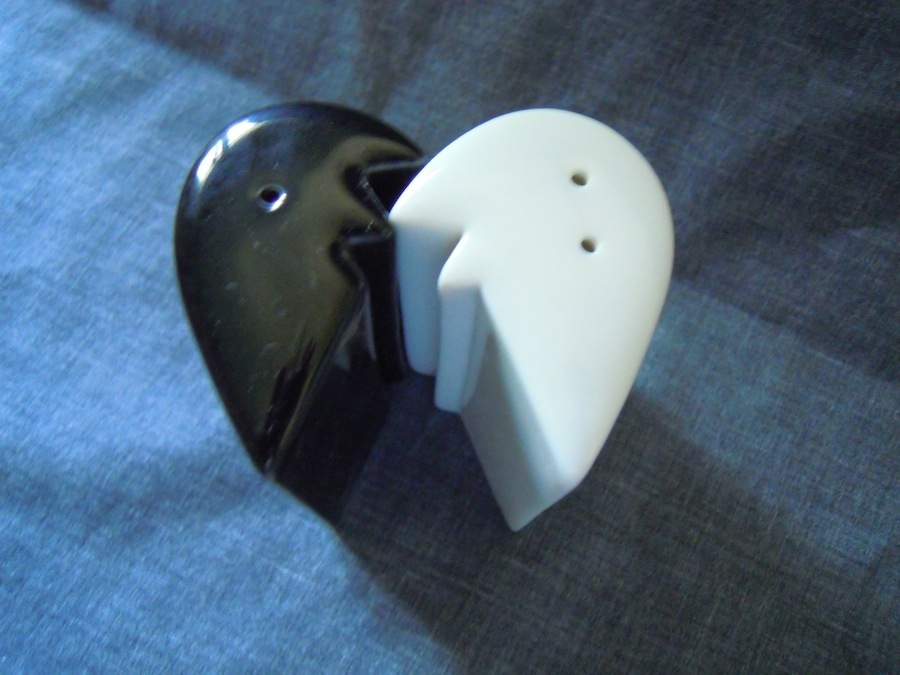
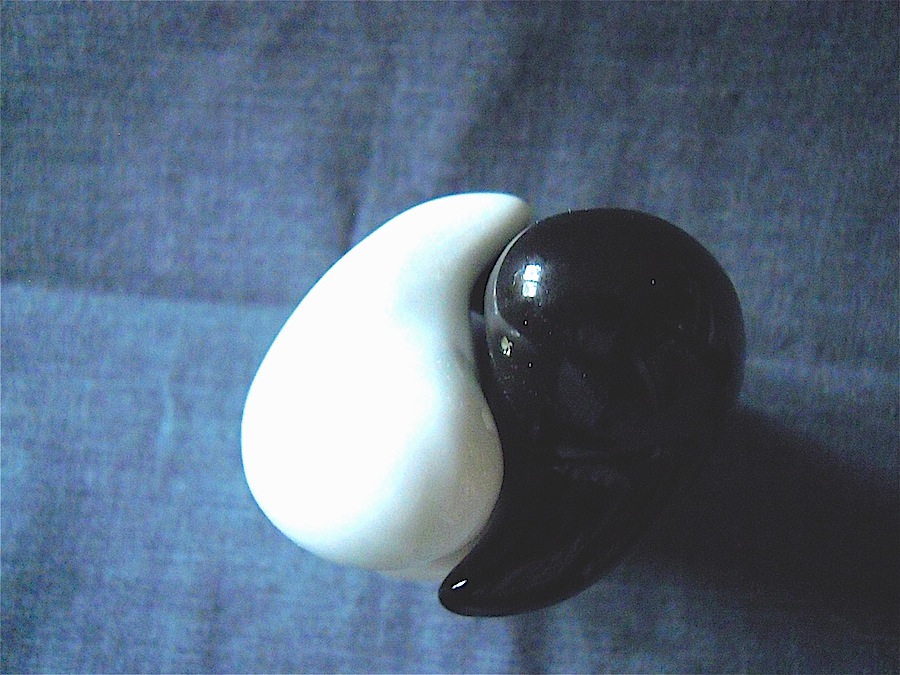
In that earlier post on mixed-race shakers, I considered a set of two figures, one black and one white, that can be placed in such a way that they appear to be hugging each other–and when they do, they form a Yin/Yang symbol when viewed from above.  Here’s another set that utilizes a similar idea. Apart, they are just oddly jagged shapes, one black, one white.  Together, they form  a more symmetrical shape. Viewed from above, they turn out to be forming a heart–an obvious symbol of togetherness, of opposites united, of black and white become one larger, better thing together.  And yet: they are still clearly marked by their original separation and opposition: one half of the heart is still black, the other still white.  And come to think of it, one might just as easily read the implied script as the reverse of coming together: indeed, in terms of how Robin Bernstein deploys her concept of scriptive things, that seems even more logical.  As one chooses to use either the salt or the pepper, one pulls the heart apart, separates the black and the white from each other.  One flavours one’s food on the basis of a rupture and an end to organized companionship (or enforced togetherness?) and love?

And then, what to make, after the seasoning is done, of the act of putting the heart back together again?

At any rate, I’m tempted to read all that as a sort of racial allegory.

Scriptive Things Again

As promised in my post of June 22, I embark now on an exploration of how novelty salt and pepper shaker sets like those in my collection might be illuminated by means of Robin Bernstein’s concept of “scriptive things.”  So what scripts for performance by their potential users do such shakers imply or invite?

I’ll start with the absolute basics. In offering their users instant access to salt and pepper on the dining table, they occupy a strangely intermediary point in the cooking/eating process. The other flavouring components of the dishes we eat have already been inserted into them by whoever did the cooking, and so things like sugar or garlic or parsley remain in the prep area and off the dining table.  It is up to the cook to decide which of those seasonings and how much of them each dish ought to have–and a cook might well be angry at guests who brought bottles of garlic salt or ground oregano to the table with them and then sprinkled these things on their food before eating it, or threw a few spoonfuls of the coffee creamer into the bouillabaisse.  The dish is meant to be complete already–except, apparently, for salt and pepper.  So salt and pepper represent a volitional part of the cooking and eating process–a halfway point at which the diner takes on part of the role of the food preparer and in a way, claims a portion of the food on the table by placing an individual stamp upon it–no longer just what the chef prepared, but now what the chef prepared with an additional level of salt and/or pepper added to it.  Why is that?  How do salt and pepper come to be on the table, and how is it that we take their presence there for granted, as just the way things are and ought to be?   What social or cultural assumptions underline that practice?  What hidden or historical scripts are represented by a container of salt and a container of pepper on a dining table?

I don’t actually know the answer to those questions–although I’m pretty sure that they could be found in histories of food and eating and table manners and dining customs.  And especially in the vast and complex cultural history of how and why we choose to season our food, and how those seasoning practices express specifics of cultural understandings.  Certainly, the presence of salt on the table has had a long history; it preceded the invention of shakers sometime in the 19th century, before which the table salt came in little dishes called salt cellars: But why that should have happened–why these two additions to food should have been singled out as the ones allowed on the actual dining table–I do not know.

What I do know is, first, that their presence on a table implies something special about them, something that makes them different from other seasonings.  One obvious difference might be that unlike a lot of other spices and seasonings, neither salt nor black pepper require cooking before we eat them.  But I’m sure there’s more to it than just that–even other seasonings that don’t require cooking, like, say, cinnamon or nutmeg, usually remain off the table.  Indeed, the difference between salt and pepper and other seasonings seems to imply something about the appropriate range of individual taste in relation to what we are required to share with others (i.e., we usually are not being invited to add more oregano to the pasta marinara we’ve been served, since there usually isn’t an oregano shaker on the table; but we are being invited to choose our own levels of salinity and pepperiness). In other words, taste in salt and pepper is acknowledged to be individual, and so, a sign of individual differences; the fact that your like more salt than I do or than the cook already put in is both a sign of your individual distinctiveness and an acceptable marker of a right to such individual distinctions.  But it is also clearly, a marker that marks a fairly narrow range of behaviour.  To add more salt to one’s soup is a sign of acceptable individuality. To add more garlic or cloves from a bottle you keep handy in your pocket, or to head off to the kitchen to get more ground cumin, is merely a sign of eccentric oddity.  And that also might imply that personal taste in saltiness and pepperiness is somehow more significant than personal taste in cloves–perhaps as a more visible and more readable social marker of difference.  Although that’s a bit of a circular argument–taste in salt and pepper has social significance because salt and pepper are there on the table and one’s use of them is public and on display–but one’s use of them is public and and display presumably because they have social significance.

History might also tell us more about how it is that salt, specifically, and pepper, specifically, came to be the seasonings that have this special status.  The histories of salt available online make claims for its significant role in the development of civilization (since it could be used to preserve meat and thus allowed survival and settling down) and especially for its preciousness in various periods.  Pepper histories make similar claims about the expensiveness of pepper; according to a Wikipedia article. “Peppercorns were a much-prized trade good, often referred to as “black gold” and used as a form of commodity money”–although where and when this happened is not specified.  So perhaps having these substances freely available on your table remains as the remnant of earlier cultural signals of one’s sophistication and one’s wealth and one’s hospitality?  Providing salt and pepper shakers on a table might then represent an attempt to make your dinner guests comfortable by allowing them some discretion about the flavours in the food your provide for them–an act of hospitality; and choosing to use the shakers might be a matter of enacting the performance of accepting the hospitality and feeling free to be an individual with individual tastes that their script implies.  Or, I suppose, not free exactly–merely free to enact a performance of individual taste that represents good manners in a social situation.

But what I’ve said up this point could apply to any and all salt and pepper shakers–including boringly utilitarian ones that don’t represent anything else, plain glass or metal recdptacleas of the sort that don’t actually appear in my collection.  So next, then, I have to explore the more specific scriptiveness of the kinds of novelty salt and pepper shakers I do collect–the kind that represent other things.

Infinite Loopiness and Racial Segregation

This link will take you to the blog Robin Bernstein’s keeps in relation to her book Racial Innocence, which I discussed in my last post, and from which I’m borrowing her concept of “scriptive things” as a potential way of understanding more about salt and pepper shaker sets.  Once you get there, you’ll discover that Robin’s post will offer you, mainly, a link back here, from which you may return to her blog, where that link will point you back here, etc., etc., in an infinite loop of scriptive linkage.

Robin also posted a link to her blog (and this one of mine) on Facebook, where one of the commenters on it said, “I also find it interesting that the salt and pepper shakers aren’t black and white (like the topsy turvy dolls, or, like pepper and salt)!” Good point.  That’s an aspect of my novelty-salt-and-pepper-shaker collection that took my awhile to become aware of:  they seem to insist on opposites, or at least differentiating categories, like salt and pepper, male and female, cat and dog, wiener and bun, even black things and white ones; but racial whiteness and blackness in a pair?  Hardly ever.  Of my over two hundred shaker sets, I can find only one that consists of a mixed-race couple:It might be significant that they appear to be some kind of nuns–apparently an order that wears frisbees on its heads.  Nuns are meant to be spiritual high-minded people who are capable of transcending mere racial categories?

Or wait, maybe they’re not nuns after all.  Maybe they’re Islamic women with covered heads heading off to the bazaar and carrying goods for sale on their heads.  So much for the holiness argument–unless they’re spiritual high-minded Islamic women whose faith allows them also to transcend racial categories?

But one way or the other, what’s most intriguing is the rarity of such a pair.  Why is it that the shakers all so take their salt-and-pepper connection so seriously that the vast majority of them depict two different but somehow related things, but that only this one set clearly marks that difference as a racial one?   If this pair are nuns, for instance, I can find other sets of nun shakers on the internet–but the differences they focus on are not racial ones.  One set consists of one nun in a black habit marked “bad habit” and one nun in a white habit marked “good habit,” thus focussing on the good-and-evil opposition.  Another shows a childishly cute nun and a childishly cute monk–the most usual male/female difference of a vast majority of shaker sets.  Another pair consists of a nun and a Catholic schoolgirl.  The European and African complexions of my nuns together in one set remains unique.

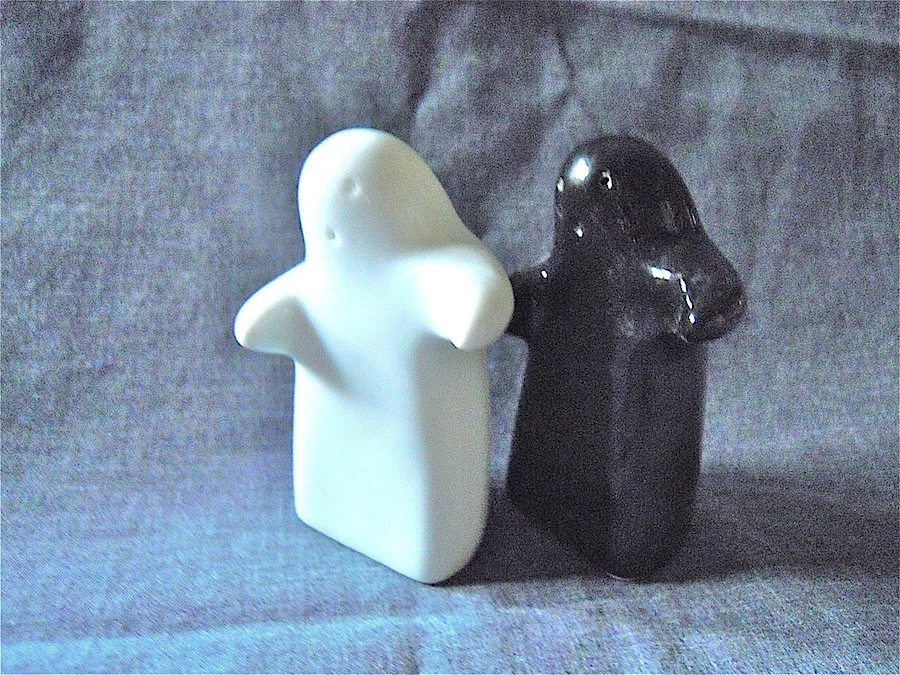
This is not to say that the salt-and-pepper miniverse avoid expressions of blackness and whiteness.  I own a set which takes advantage of that opposition to, supposedly, make a point about peace and brotherhood.  

The thing is, though, that they can be positioned in such a way that they appear to be hugging each other:

In this pair, according to the advertising copy that accompanies it when it’s for sale at numerous places on the internet, “The bold use of black and white suggests that we are all brothers and sisters on this planet and we need to treat each other with kindness, compassion and respect.”  But despite the apparently obvious connection between a black shaker and a white one as representations of brotherhood and the racial categories of blackness and whiteness, and despite the obvious need in our world for racial brotherhood, this set actually seems more interested in another form of unified difference; the shakers, in hugging position and viewed from above, :

That makes them a representation of maleness and femaleness and not specifically racial at all, not then actually using the blackness of salt and the whiteness of pepper as a racial metaphor.

There are, of course, lots of depictions of race in the salt-and-pepper world, and always in my experience, stereotypical ones–look at my previous posts of a few months back on sets that depict indigenous North Americans, and then another set of posts on ones that depict African Americans and in one instance, an African. Most often these sets tend to present two people of the same race or ethnicity, almost always one male and one female.  So gender difference and connection is exceedingly important in the salt-and-pepper world; and when race is present, it is race that is clearly  gendered into two different shakers, one M, one F.   But while there is always one shaker for S and and one for P, one for black seasoning and one for white seasoning, racial blackness and racial whiteness are almost always segregated from each other, kept isolated in separate sets.  In an imagined world that insists on the bringing together of obviously visible differences, on pairs, racial blackness and racial whiteness appear to be a huge exception. Fascinating.

Scriptive Things

I

n her recent book Racial Innocence: Performing American Childhood from Slavery to Civil Rights, Robin Bernstein offers an insightful and innovative analysis of the ways in which ideas about childhood, texts about and for children, and objects representing children and/or intended to be used in their play intersected with and were inflected by ideas about race in nineteenth and twentieth century America.   She performs her analysis of  objects like toys and dolls by identifying them as a what she calls “scriptive things”: items of material culture that prompt meaningful bodily behaviors, that is, suggest in the repertoire of meanings they imply and the narrative that sustains them specific ways of interacting with them–much like the scripts used in the theatre: “the set of prompts does not reveal a performance, but it does reveal a script for a performance.  That script is itself a historical artifact.  Examination of that artifact can produce new knowledge about the past.”

In other words, reading a script is a matter of applying what one knows of a range of relevant matters: not just knowledge of the place and time and kinds of people it describes, but also the theatrical practices it implies, the knowledge of stagecraft that might allow one to envision or produce a performance of it and of the context of historical and current theatrical performances it might relate to or vary from.  A production of a play is then shaped by its script, even though each new production of that script is likely to be different from others.  The script, as Bernstein suggests, invites certain ways of making use of it without absolutely demanding them.

Toys, dolls, and all the other objects we human beings interact with equally invite certain kinds of behaviour from those who make use of them–and as a result, we can explore them in terms of figuring out what those scripts might be.  We can read them in terms of discovering how they both express the values of the culture that produced them and help to sustain and shape that culture by inviting certain ways of interacting with them–ways of behaving that have moral, ethical, and cultural implications.

The objects Bernstein describes include a variety of depictions of people of African descent–object like Stafffordshire figurine of Uncle Tom and Little Eva (of Uncle Tom’s Cabin), like this one held in the Hunter Museum of American Art, and like this mammy and white child topsy turvy doll.

As I read Racial Innocence, I learned a great deal I hadn’t expect to learn about how concepts of race have found expression in American culture in a variety of ways, in a number of surprising contexts, and in a number of surprisingly subtle scripted actions invited by a range of interesting (and interestingly scripted) scriptive things.  But I also found myself thinking that much of what Bernstein had to say about the scriptive things she described might also be applied to novelty salt and pepper shapers–most obviously, to ones like those representing black stereotypes like the one I’ve described in previous entries, such as this set of Aunt Jemima and Uncle Mose I discussed here and here:

Aunt Jemima and Uncle Mose

But, I found myself thinking, why stop there?  The concept of scriptive things seemed like an intriguing and, for me, new of thinking about the objects we surround ourselves with and use on a daily basis.  It might well throw light, not just on the shaker sets with African American connections, but on a whole range of other sets depicting a whole range of different kinds of subjects.  So I’ve decided to do some thinking about that, in a series of entries to follow.

Miniature, Lifelike and Dead

This is a nester and a go-with, both at once.  Not only is it  a slice of toast to go with a toaster, but the slice of toast nests into the toaster: After that, though, I really have nothing much to say about it.  It’s cute of course, in the way that miniature versions of things are always cute–that paradoxical combination of accurate verisimilitude and inaccurate littleness that somehow allows viewers to truly enjoy something and have positive feelings towards it while, or because of, feeling superior to it.  And again like all miniatures, its power seems to lie in the way in which it so both accurately represents larger objects and disempowers them–makes them safely littler than we are, makes them useless, deadens (or immortalizes) them (this toast will never go stale, and the toaster cannot ever actually make toast).  Not that toast or toasters are in obvious way threatening to us, but maybe they are threatening merely in being real and out there, part of a world that surrounds us and therefore belittles us somehow, makes us aware of our limitations and our own littleness in relation to the magnitude of everything else that isn’t us, isn’t me.  So we triumph over its threatening not-me-ness by making it little, belittling it, seeing it as cute and thus enlarging and empowering ourselves?  Then does this sort of cuteness somehow emerge from both the lifelikeness and the actual deadness, the lack of life, of the object?  I think it must, and I think that somehow that accounts for the peculiar combination of adorability and dismissiveness such objects seem to arouse–that the recognition of what we call “cuteness” always seems to arouse.  Cuteness is deadening to cute things, and therefore life-giving to perceivers of cuteness.

Well, so maybe I had a little to say about this set after all–but as a representation of its category, not in terms of the specific objects it is and the specific objects it represents.  What the specific appeal of a miniature slice of bread and a miniature toaster?  The set makes sense as one of a collection of equally miniatured objects, like, say, the furniture in a doll house–but why specifically toast, why toaster?  Might it maybe be designed for use on a breakfast table?  Perhaps.  But I have a sense that anyone who might actually have chosen to put these to use on a dining table would be less interested in the particularities of the particular object depicted than in their shared idea of miniaturization and cuteness.  In other words, any of a number of shaker sets that represented bigger things in a smaller but fairly accurate way would do, and this one just happens to be toast and toaster?

There’s also something about the shininess of such objects–but I’ll leave that to think further about later.