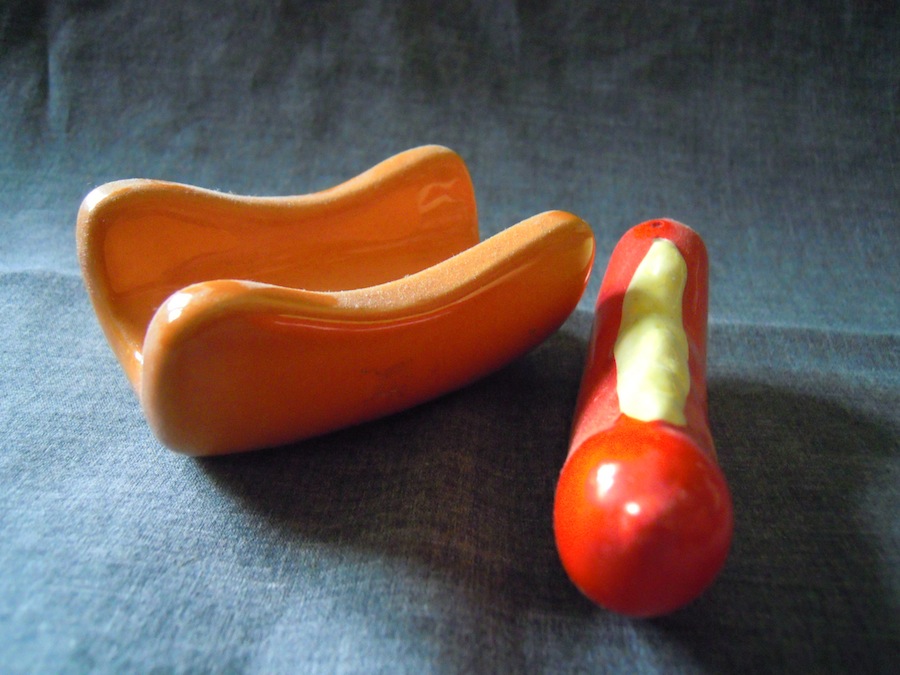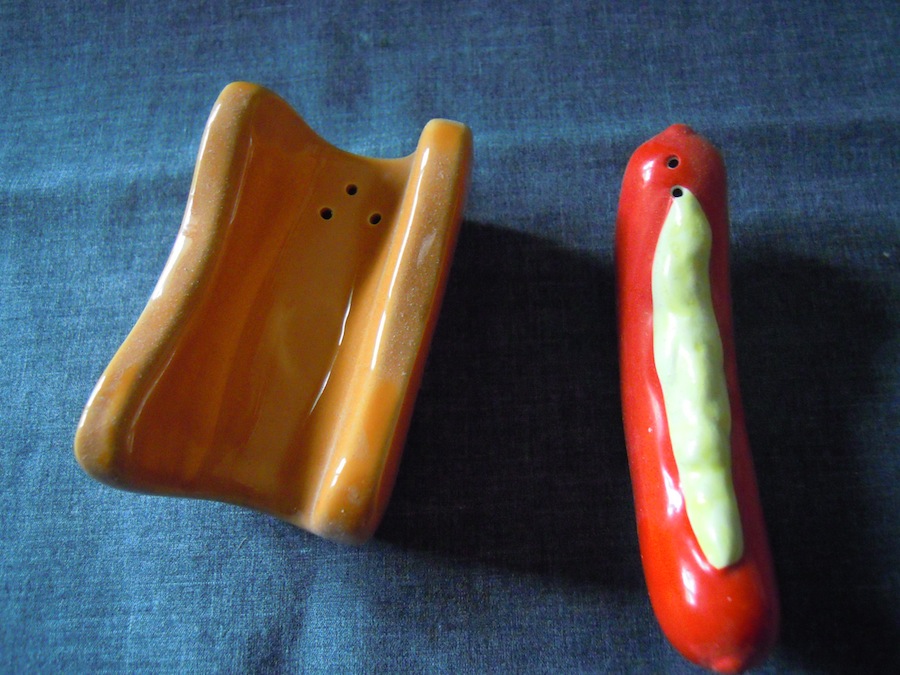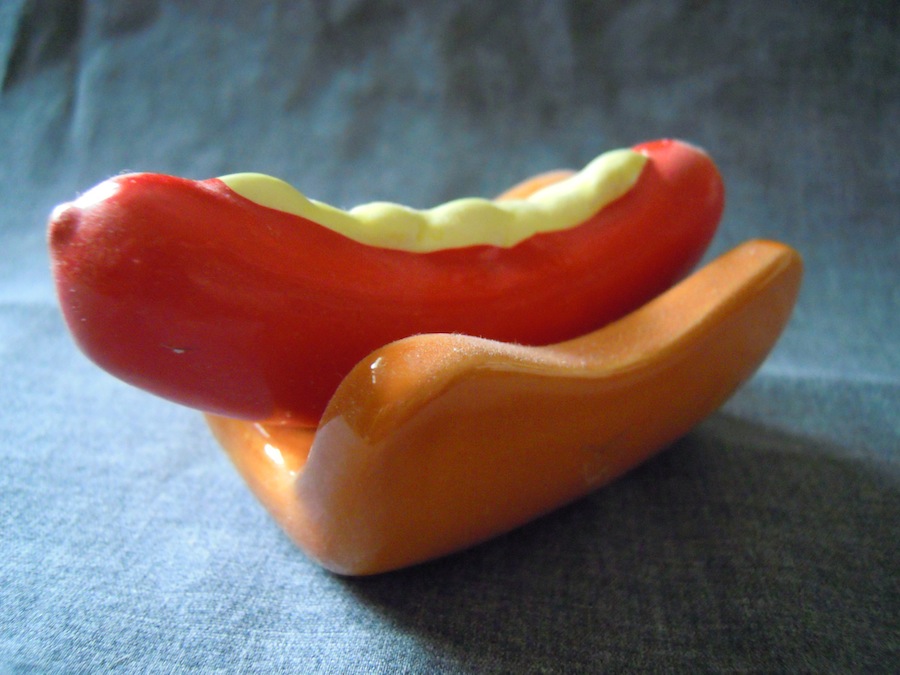
Unusual Bisectionality

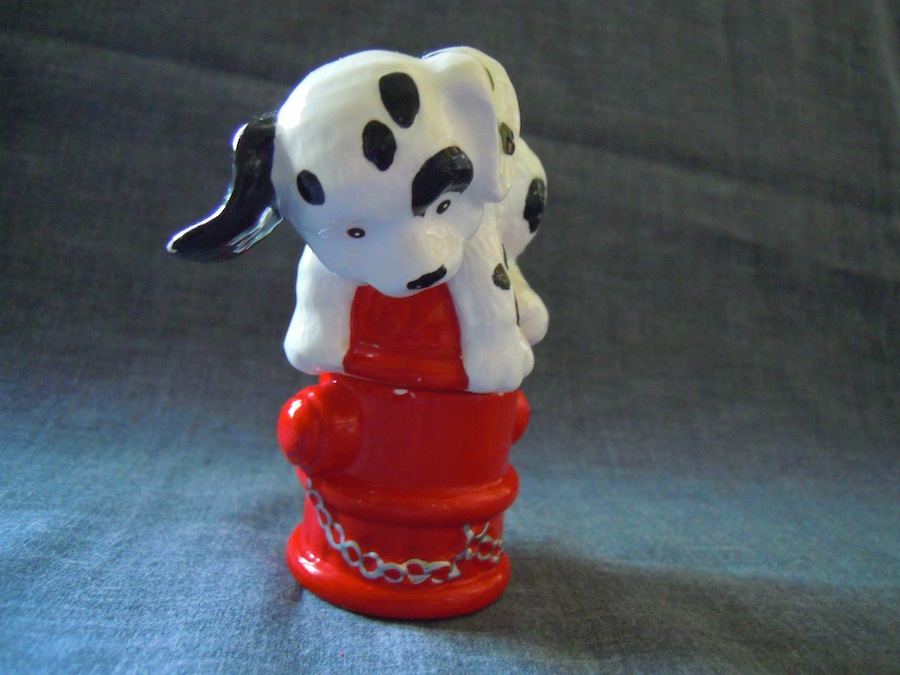
At first glance this is only a little bit weird. It involves a dog and a fire hydrant, as did the subject of an earlier posting:But that dog was doing the sensible doggy thing and peeing on the hydrant.  This one, for no apparent reason, has nested itself atop the hydrant.  Was the dog attempting a long jump over the hydrant that failed spectacularly?  Perhaps it is some sort of act of declaring ownership, for the dog is, its spots suggest, a Dalmation, and Dalmatians have a longstanding historical association with fire departments.  Perhaps then this shaker set symbolically represents the synergy of the Dalmatian breed and firefighting equipment?  It’s possible, I suppose.  But still a little weird.  How did the dog get up there anyway? And above all, why?

But things get weirder when we split the nester from the nest and new the shakers separately:They do not emerge as one might have expected, as one dog no longer nesting on one hydrant.  Instead, the bisection leaves the dog attached to the top of the hydrant, and the hydrant without its top.  That does, of course, allow the dog to sit flat on the table on its own.  But that practical functionality does not prevent the imagery from seeming strange and unsettling.  Is the dog somehow glued to the hydrant?  Has the dog confused the fire hydrant with an object of desire and forged a long-term relationship from which it cannot extricate itself, at the cost of the hydrant’s integrity?  What sort of fire hydrant has a removable top?  And if you did remove it, wouldn’t water be gushing out?

As both this shaker set and the one I described in my last post, in which the bubbly liquid somehow followed the girl who swam in it out of the cocktail glass she swam in, the liquid all the while keeping the shape of the glass that once held it, the art of nesting in the world of salt and pepper shakers can be problematic.
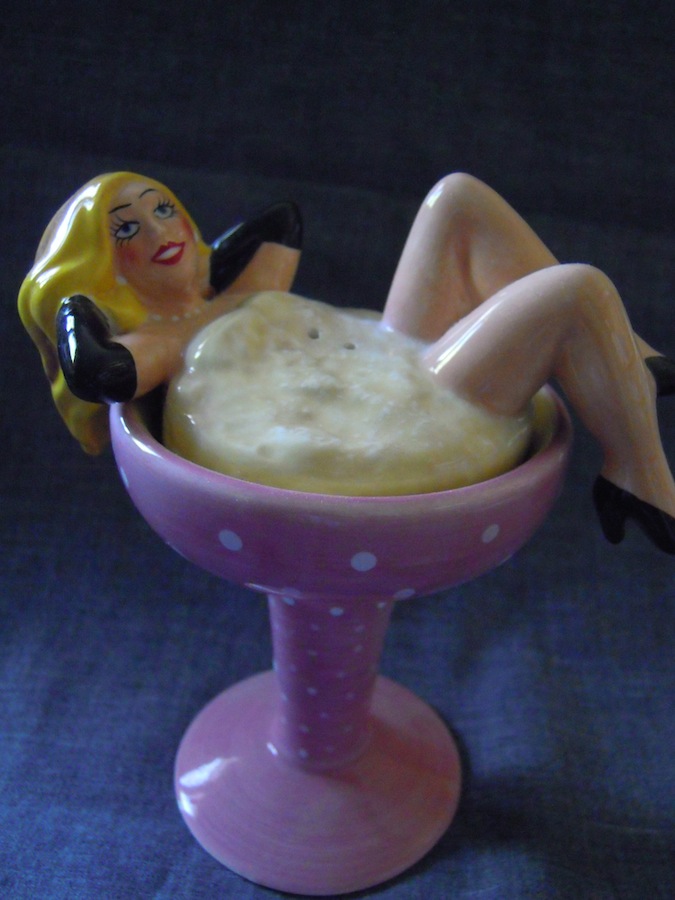
Bubble Barf?

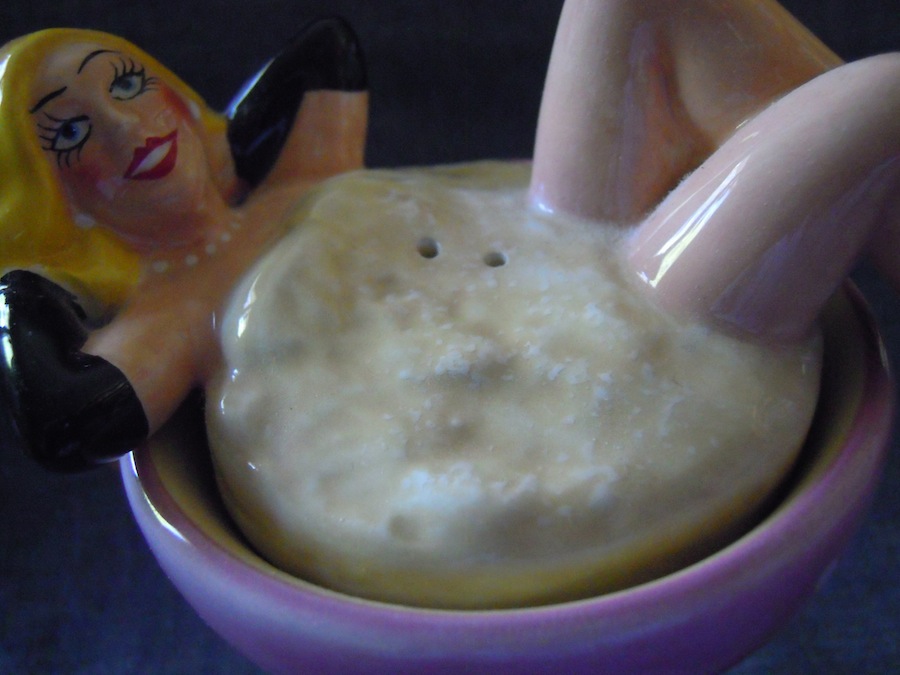
This is a nester:It represents a young woman in a cocktail glass–either a very tiny young woman or a very huge cocktail glass. Or wait, maybe it’s not actually meant to be a cocktail glass, but just in the shape of one–for few cocktail glasses are opaque mauve with white dots. So maybe it’s just a sizeable mauve bathroom sink, or small bathtub on a pedestal. One way or the other, though, it seems to signify the frivolity and lightedheadedness of champagne and jazzy nightclubs, a gay life in a different time when gay meant something different than it does now. So the set is, I suppose a kind of old-fashioned symbol of a sophisticated (or sex-crazed) life of wild abandon, a Playboy or even older and better, Esquire magazine lifestyle. Exotic cocktails and tempting wide-eyed blondes wearing nothing but long black gloves, high heels, and soap/champagne bubbles. What the with-it crowd in the Big Apple was supposedly up to as represented for the little old ladies and gentlemen of Dubuque.

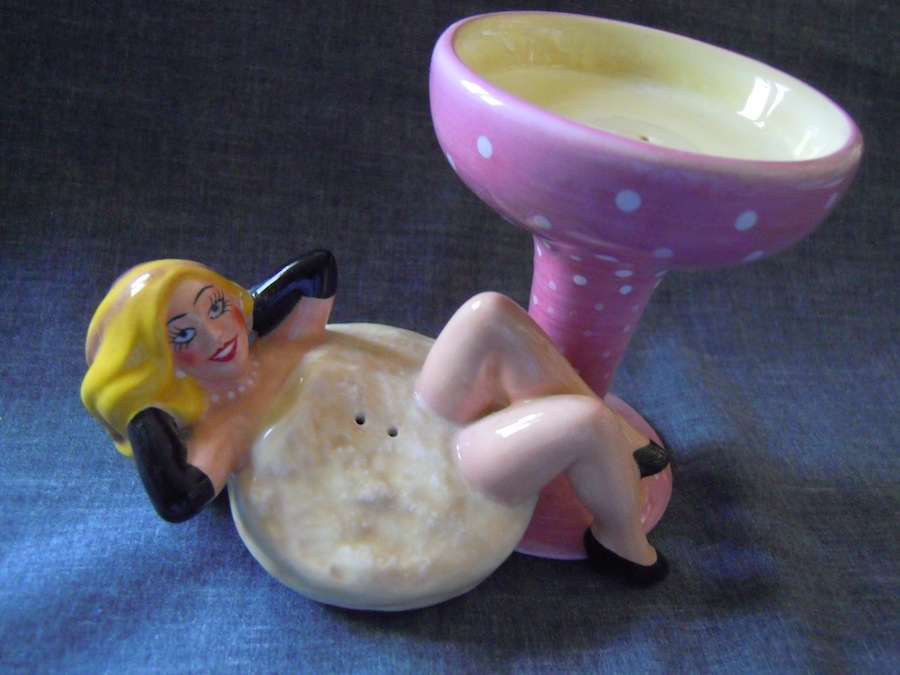
As a nester, of course, the set comes apart as two separable components: the cocktail glass/bathtub and its contents:What is odd here (beside the fact that the condiment-holes seem to have ended up providing the young lady with two navels) is that the contents of the glass have accompanied the young lady on her journey out of it. somehow that focuses attention on those contents–and thus, reveals how disturbing odd they are. They are strangely beige–a beige quite unlike the colour of champagne bubbles. Since they retain the shape of the glass/bathtub even after having been removed from it, they look weirdly like a cookie, as if the sexy young woman had been baked into dough: Or, no wait, not dough, for it still looks kind of liquidy. Like . . . Well, like vomit.

And so, a true depiction of the dissipated life after all.

E.T., Go Home

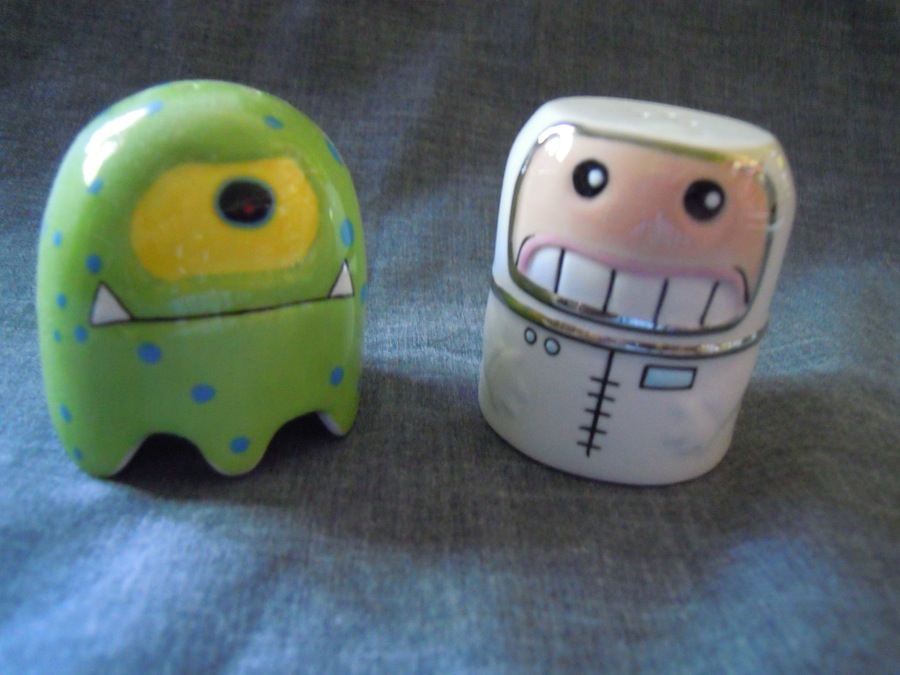
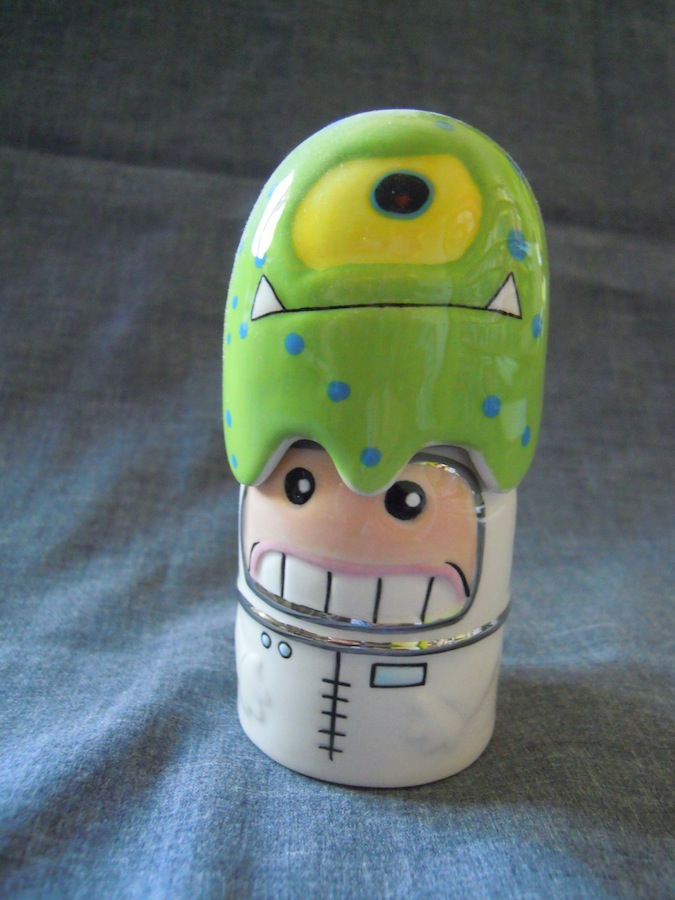
This is another example of a stacker (or nester).  As two separate pieces it represents a somewhat odd couple brought together, it seems, by their shared connection to outer space: One is some kind of one-eyed alien or ET; the other appears to be an astronaut in a G-suit.  Neither appears to be happy, the reason for which might become apparent when they are viewed in their stack formation:However the one landed on top of the other, neither seems to like it all that much. They ooze the unhappy feelings of an old song of my childhood about a similar situation, David Seville’s “A Bird on my Head” (1958) which was, I recall, a follow-up to Seville’s huge hit “Witch Doctor,” source of the immortal chorus “Ooo eee, ooo ah ah, ting tang, walla walla, bing bang”).  In “A Bird on my Head,” we are told,

I’m just sittin’ in a vacant lot with a bird sittin’ on my head

I’m just sittin’ in a vacant lot with a bird sittin’ on my head

Wicked, wicked, cruel, cruel world What have you done to me?

I belong in someone’s arms

At which the bird adds in a comical bird voice, “And I belong in a tree.”  In this case of further evidence of the wickedness and cruelty of the world, the astronaut belongs on some space ship or other, and the ET belongs in some alien tree.  Or treelike structure.  And instead, alas, the one is wearing the other like a particularly ugly hat.  I don’t know why, unless it’s some sort of minor joke about the dangers of exploration in unknown climes, or about the dangers of mixing with those significantly unlike oneself–a sort of shaker-world racism?

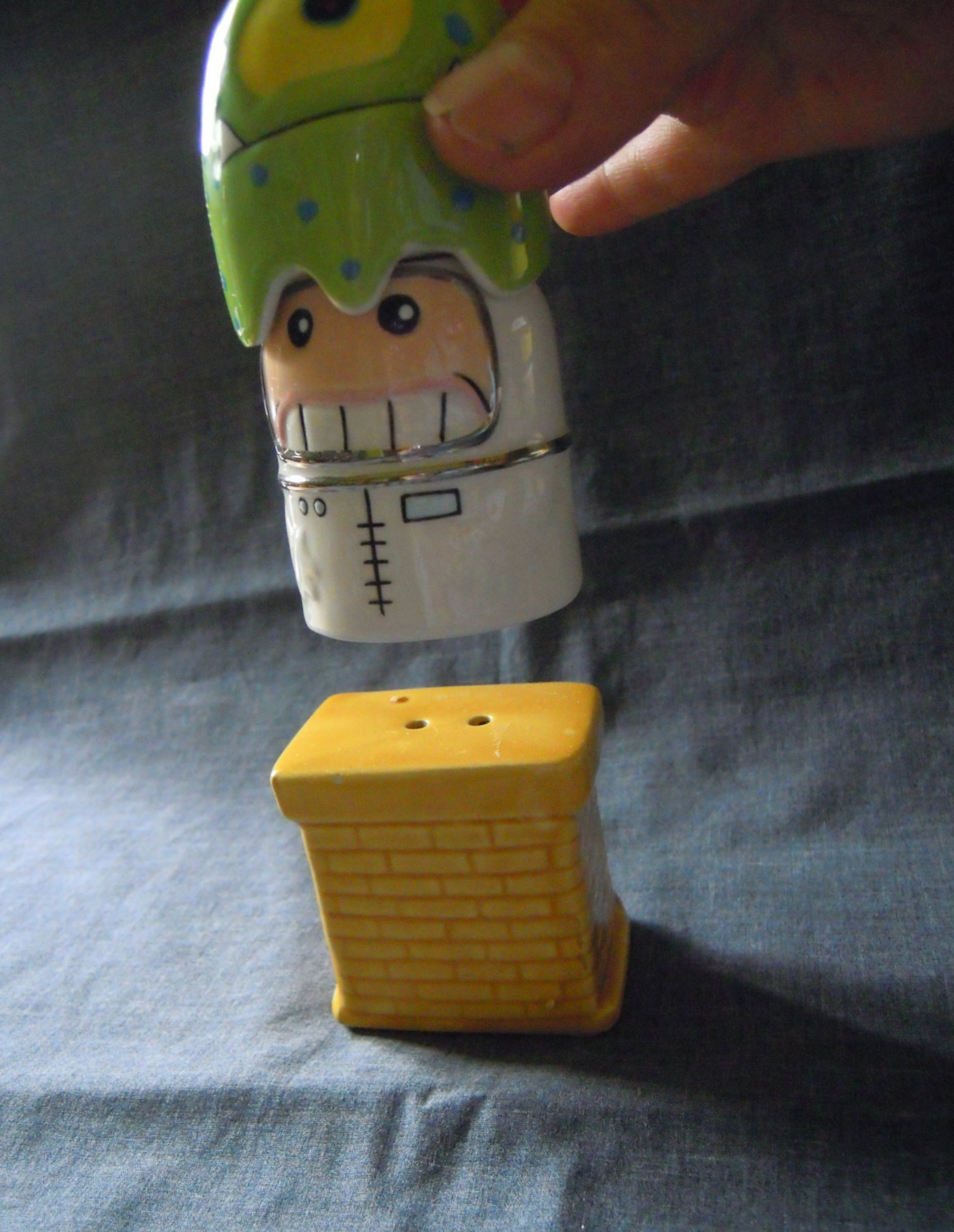
On the other hand, this shaker set does literally represent the ways in which opposites attract.     They are not merely stackers or nesters.  They also represent another special type of shakers: those that are magnetized.  In this case, it is quite difficult to separate the ET from the astronaut because the two have an actual magnetic attraction to each other–as can be seen here: (the yellow object belongs to another shaker set–I just put it there to make it clear that the ET/astronaut were suspended in space).  There is an actual set of magnets embedded in them that confirms and controls their mutual attraction.

But I’m still a little mystified about what’s supposed to be going on here.  It’s a kind of somewhat absurdist whimsy that has only the barest of connection to the world we actually live in.  It cute, but this time, a kind of cuteness more or less completely unhinged from actual living beings like babies or kittens.  It’s not the kind of cuteness that relates to specific real beings we might want to admire/despise/belittle/adore, but the kind that spreads out to become an attitude to all things generally.  Ain’t life cute?  Ain’t astronauts or aliens–or trees or lawyers or sofas or anything else you can think of–cute if you thinks of some way of making them cute, of cutesifying them?  Or at least, isn’t it a nice escape from what’s most likely to be a depressing consciousness of the world’s inadequacies to imagine a place of utter cuteness where all things are equally to be looked down upon adoringly?

Or something like that.  My thoughts about this are obviously not yet as clear as they might be.

Perhaps a Tinge of Sexual Innuendo?

Writing my last post about the hot dog and wiener nesters, I found myself being reminded of a scene in one of my favourite books for young people, Brian Doyle’s Angel Square, and especially this scene describing a conversation the main character has with one of his classmates:

I was remembering something that happened with Fleurette Featherstone Fitchell in my laneway one time.

She drew an oval in the dirt with a stick. Then she cut it in half with another line. It looked like the side view of a hamburger bun.

She asked me if I knew what it was.

“It’s a hamburger bun from the side,” I said.

“No it isn’t, silly!” she said. “It’s something I’ve got that you haven’t got.” Then she drew what looked like a cigar in the dirt with her stick.

“Guess what that is,” she said.

“A cigar,” I said.

“No it isn’t, silly!” she said.

Then she asked me if I wanted to see hers.

He never does get to see hers; it’s a novel for children.  But anyone who wants to can look at my hot dog by viewing my last post.  And, for that matter, my hot dog bun.  And by the way, I intended no sexual innuendo in the reference to my last post.  It was purely accidental.

On Top of Old Smoky–and Other Places to Be on Top of

In my last post, I talked about a shaker set that consisted of two parts of Mt. St. Helen’s: the top part of it that blew off in 198o, and the bottom part that remained behind.  According to the website of the Novelty Salt and Pepper Shakers Club,this makes my Mt. St. Helen’s set a representative of a specific kind of shakers:  nesters or stackers.  According to the Club,  a nester or stacker is a set in which:

  • One of the shakers sits upon part of the other without touching the shelf.
  • The base shaker totally supports the upper shaker.

In this case, the top of the mountain sits upon the bottom, and the bottom totally supports the top.  As I look back over shaker sets that I’ve discussed in previous entries, I see that a number of them are nesters or stackers:  the removable breasts of a naked woman sit on her torso, thus making her a stacker–and a well-stacked one (sorry; couldn’t resist);  the two lobster chefs in the processs of preparing themselves for dinner nest inside of the pot they appear to be planning to cook themselves in;  the pearly pink young lady gets stacked on tip of the chair she sits on.  No part of the breast, the lobsters, or the young lady sits on a shelf.

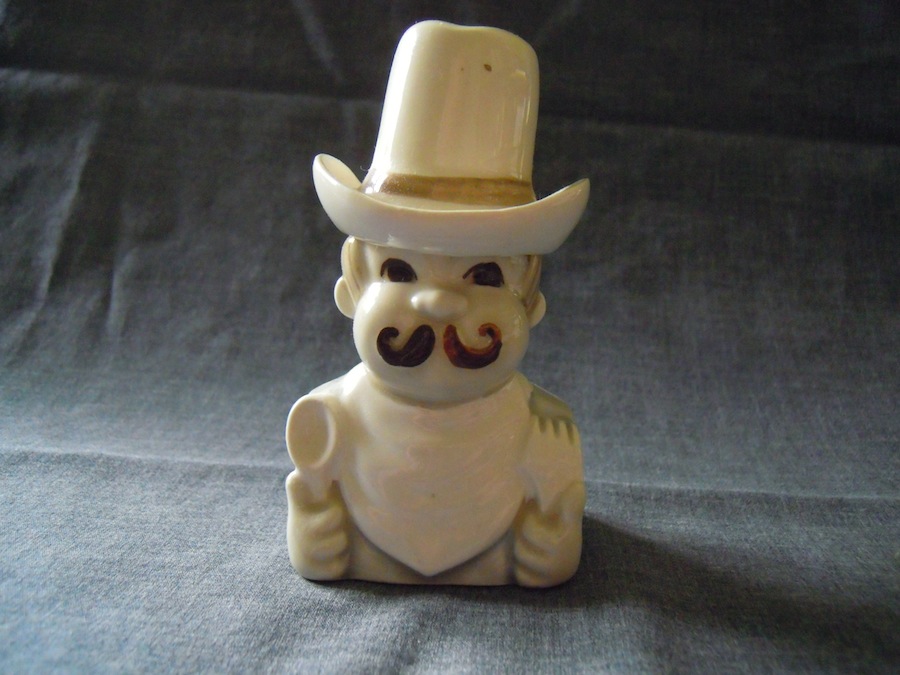
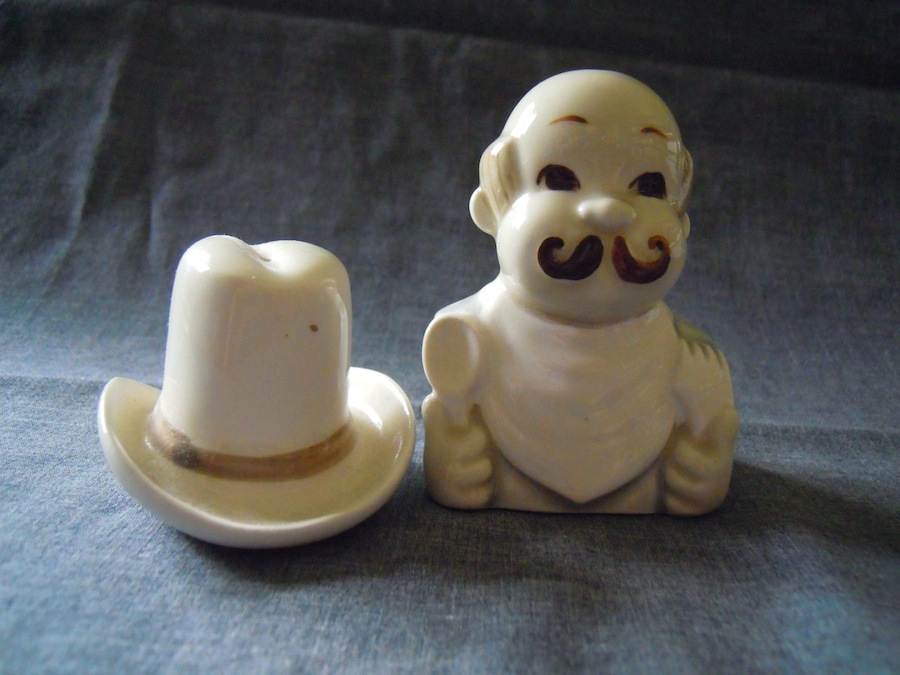
Here’s another set of stackers to add to the collection:At first glance, this appears to be just one piece of earthenware.  But if it were just one piece, it could hardly provide both salt and pepper, right?  And so, it turns out to be two pieces after all: You can choose your condiment from either the man or his hat.

This nesting and/or stacking represents a fairly prevalent ingenuity factor in salt and pepper sets–a way in which they do something more than just represent something–something physical that makes their connection with each other kind of clever and also, (here’s the word again) kind of cute.  Because it’s cute that your pepper shaker would sit on the head of your salt shaker, especially since one is a hat and the other is a head.  I mean, who woulda thunk it, eh?  And yet, once you do think about it, so obvious and apropos.  The hat actually comes off the head, just like a real hat.  So gosh darned, all-fired adorable.  It’s yet another aspect of the set that encourages a kind of response to the set’s adorable novelty (as in, .e.g. the whole idea of novelty salt and pepper shaker sets in general, that they are novel, unusual).  This is an invited response that is both approving of it and, at the same time, more than a little dismissive.  Why dismissive?  Because the ingenuity is so completely and entirely pointless, and really, so completely and entirely without any sort of significance, so entirely self-contained.  The hat sits on the head because the hat sits on the head, and for no other more practical or useful purpose–because hats in reality do sit on heads, and wouldn’t it be cute and sort of clever to represent that in miniature earthenware?  It’s another aspect of the set that makes it little and safe, and admirable in its littleness and safeness.

Even More Accurate Souvenirs

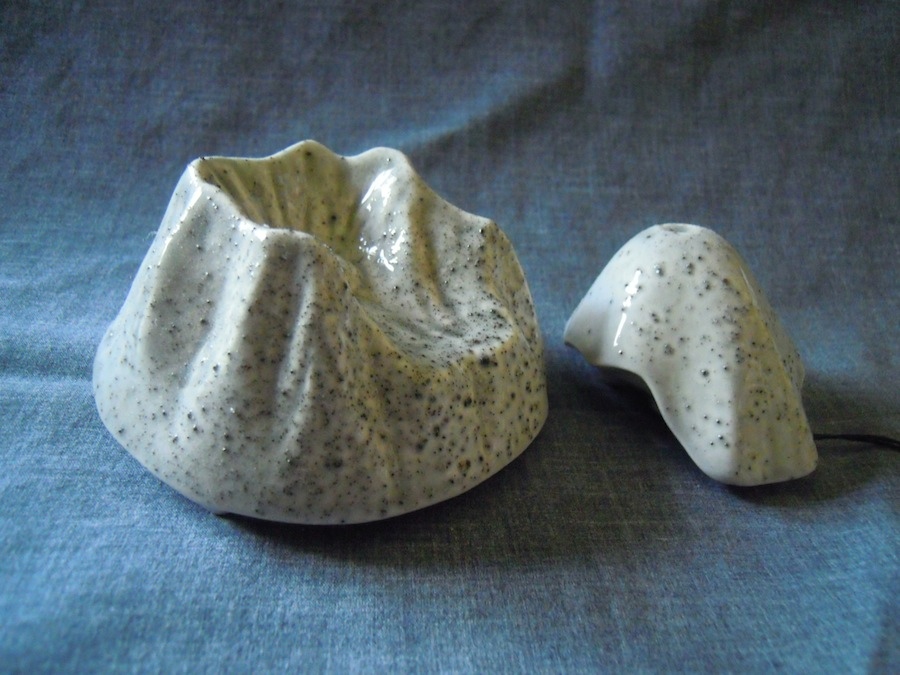
In my last post, I talked about a souvenir shaker set that was a miniature representation of an actual building. This time, an even more accurate set of shakers claims actually to be made of part of the thing it represents. At first glance, it might be a little hard to figure out what it’s trying to represent:

20120523-100119.jpgBut things get easier to understand once you figure out how the two things are supposed to fit together–one on top of the other:

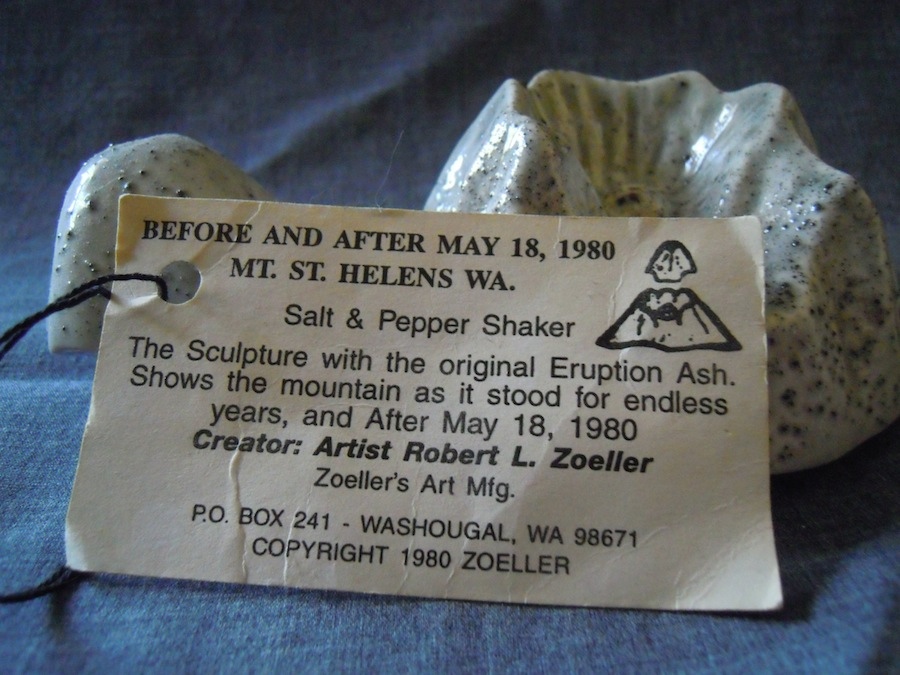
20120523-192230.jpgWell, okay, so maybe it’s still not so easy to figure out. Fortunately, there’s a label attached to this set that explains everything:

20120523-192428.jpgNow it becomes clear that this set is an attempt at an accurate representation of Mt. St. Helen’s. One piece represents the top of the mountain, as blown off in the 1980 eruption. The other represents what was left after that top was blown off. Or in other words, this is a before-and-after set: the two pieces placed on top of each other represent what the mountain looked like before the eruption, the bottom piece on its own after you remove the top what it looked like after. The movement of a user in choosing to pick up one or the other shakers in order to season some food then replicates the action of Mother Nature in blowing the top off the mountain. You salt your food and you make a volcano happen.

But wait, folks, there’s more. not only does this set look like and act like a volcano erupting, but also, the material it’s made of includes actual ash left behind by the eruption. It is itself actually part of that which it represents.

I’m not sure I know what to think about this. It seems significantly different from all my other shaker sets. I don’t, after all, have a shaker set representing Aunt Jemima made out of real pancakes. Or, for that matter out of a read woman of color (although unfortunately I can imagine kinds of people who might be happy about possessing such a disgusting thing–all too easily). and yet, this set still works as a miniaturization of, and so, I suspect, a sort of defanging of the enormity of the eruption. It’s a cute surrogate that makes thinking about the vast forces of nature more manageable–and more dismissable? On the other hand, this set, with it’s rough ashy surface, feels much different from most other shakers–not sleek and shiny and smooth and safe, but shiny and yet rougher, abrasive a little, still redolent of the danger of its origins.

Accurate Souvenirs

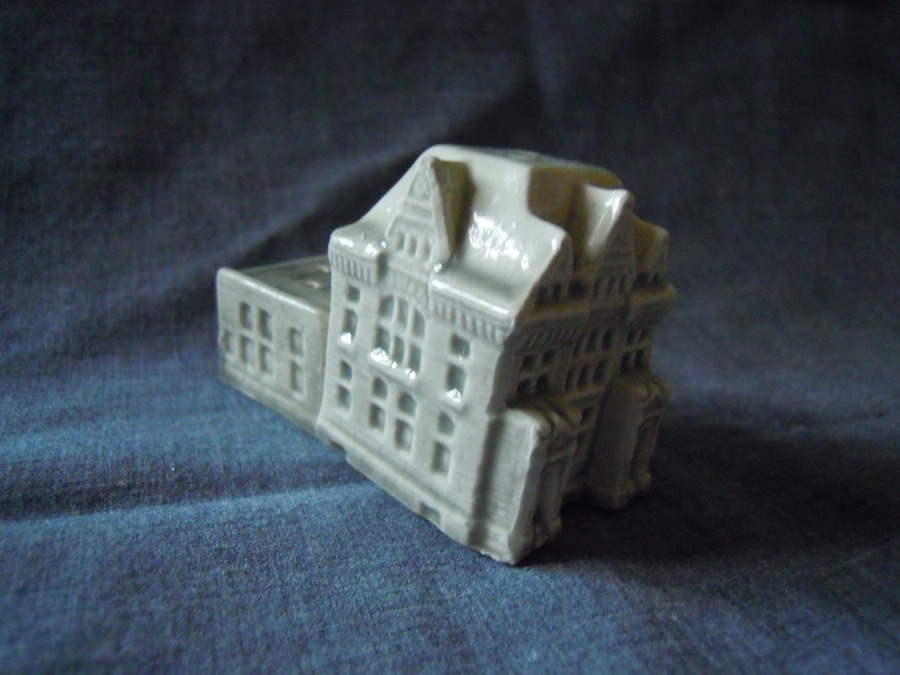
Unlike the Banffian lions and chuck wagons of my last post, this pair actually has something to do with the place it claims to represent:ImageIt is, in fact, a salt-and-pepper version of the Portage La prairie, Manitoba city hall.  The city hall has been divided into two parts, one for salt, one for pepper, like so:If you look closely at the top of the smaller of the two shakers, you can read the words:

PORTAGE LA PRAIRIE

CENTENNIAL

1880-1980

CITY HALL

And the bottom of the other piece also makes the connection to Portage by naming it (visible upside down in this photo):It also tells us that these shakers are a product of CanTage Ceramics–a company which, they internet informs me, still exists in Portage–CANadian PorTAGE?

So would I rather receive this set as a souvenir of a visit to Portage than, say, a generic pair of Canada Geese like the ones I have that claim to represent my own town of Winnipeg, or, say, a Portage-celbrating lion and tribesman?   Difficult to say.  There’s something pleasingly diminished about an actual city hall made tiny and in shiny breakable ceramic.  As much as it accurately depicts the Portage building, it still looks like it belongs in an adorable Christmas village alongside some  Victorian carollers.  As a representation of what I have to admit I think of as a fairly boring mundane little town on the prairies, this set romanticizes its place, makes it seem more interesting, more cute and cuddly–more souvenir-worthy, more happily visitable.  Or perhaps what I’m really saying is that the Portage City Hall in a shaker set is just as bizarrely and adorably unreal as a representation of the place as are the tribesman and the chuckwagon of Banff.  In the shaker world, apparently, the cuteness of miniaturization trumps realism every time.

A Cowboy in the Mountains

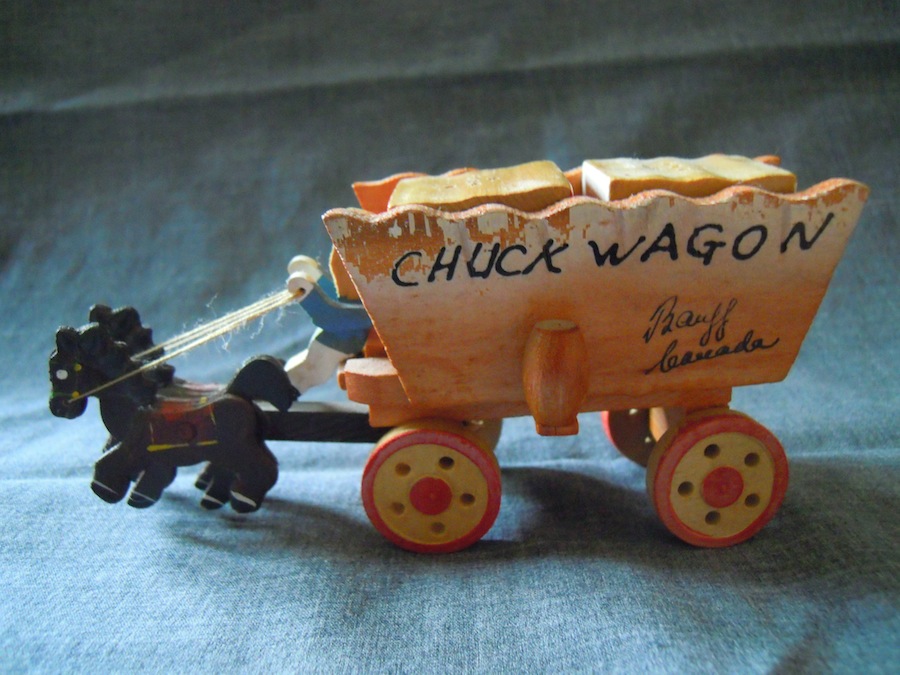
As I suggested in an earlier post, Banff, Alberta is represented in the world of salt and pepper shakers in a wide spectrum of ways:   a pair of golden hands, a pair of ungrammatical aboriginals, a lion and a grass-skirted person of African descent.  Here’s another odd addition to that very miscellaneous assortment:Well, perhaps it’s not so odd–at least not so odd as the lion and his/her friend: for after all, Banff is not all that far from Calgary, where they have chuckwagon races at the annual Stampede.  But that’s far enough away to be down on the prairies–it’s harder to imagine those wagons racing around right in the shadow of the Rockies that surround Banff itself.  And are there not shaker souvenirs of Banff that do in fact in some way evoke these mountains?  So far, at least, I don’t have such a set.

It all makes me wonder about how this whole business of souvenirs of places people have visited operate.  You bring home a souvenir presumably as what the word “souvenir” implies–as a memorial to the visit and the place, a device that allows you to preserve or evoke and indulge in your memories of the place, or as a sort of passive-aggressive reminder to others who weren’t on the trip that you got to go there and all they got was this gift from you of a lousy set of salt and pepper shakers.  But apparently, the memory or the envy can be evoked by a representation of just about anything: as long as the shakers have the name of the right place printed on therm, it doesn’t matter if they are golden hands or racial stereotypes of minoritized local residents or people from an entirely different continent.  And perhaps you choose the lion and companion over the golden hands because of a personal taste and interest in Africa, or hunting, or race relations–which means that the more significant meaning of the shaker souvenir is not the place it names but the personality and character of the person who buys it.  In other words, you’re remembering or memorializing or confirming yourself–which surely you didn’t need a ceramic African or golden hand to do?

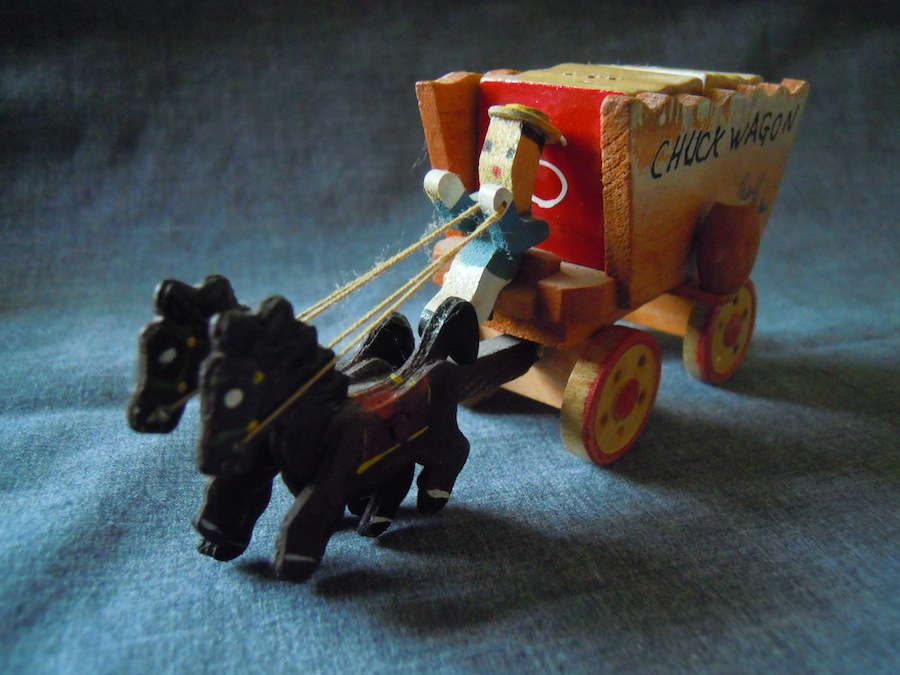
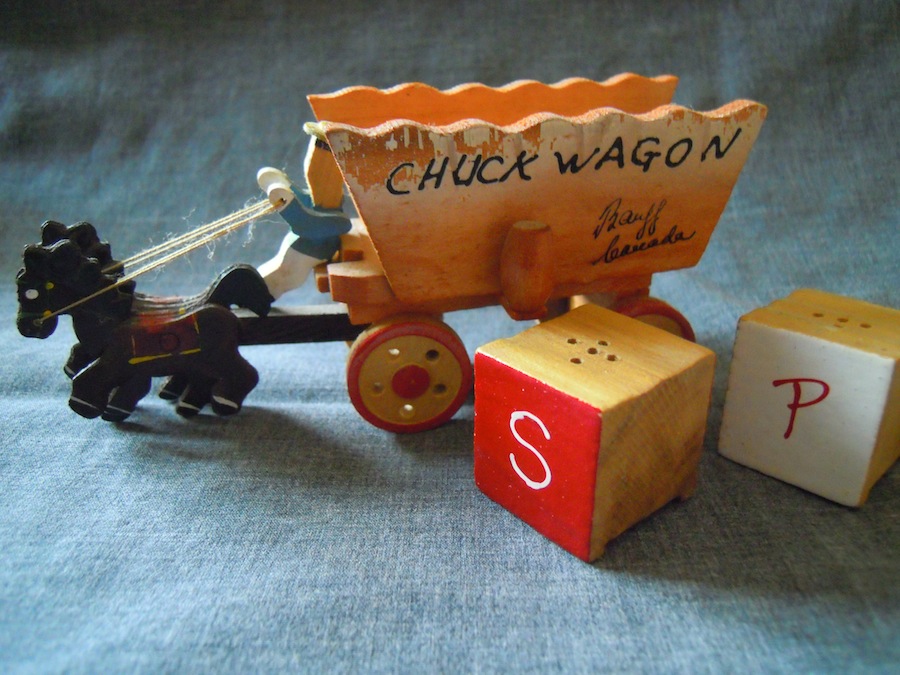
This chuck wagon is made of wood, in a pleasingly primitive style of carving, and has a very simply outlined driver, who, despite his simple outlines, manages quite successfully to communicate the actions of a driver on the go:He looks a little like a clothes peg.  Oh, and for those who might wonder how this qualifies as a salt and pepper set: the shakers are to be found as the load the wagon carries.  Here they are removed from their perch and with their shakerhood more clearly on display:

Black Like Each Other

Now that I’ve discussed a group of shakers that represent stereotypes of people of African decent in different posts, I thought it might be interesting to see them all together: What intrigues me is the familial resemblance they have to each other.  Whether they’re heading off to sea in Clyde, Alberta or hunting lions in Banff or riding in the Sui Choi Derby or whomping up some pancakes, they all look sort of alike–same or similar skin tones, same round eyes, same bright red lips (often very thick), same happy smiles.  The stereotype recurs again and again.  It has a tyrannical hold on the imaginations of novelty-salt-and-pepper-shaker designers.

And the overall effect?  As I look at this photo, I can’t help but respond positively to how cheerful and jolly and upbeat this group of misrepresented and oppressed people nevertheless seem to be.  I know that these objects are distressingly racist, and yet (or and so?) they exude innocent happiness, an aura of nothing to be worried about.  That seems to be exactly the point.