Two Seated Ladies

A seated woman sits down for a chat with another seated woman:The newcomer is a much more business-like looking woman.  She has a crisp white collar, and no flowers, no puppy, no gardening hat.  Is she, perhaps, a therapist of some sort, trying to assist our old friend with whatever horror it is that has caused those eyes to be shaped like teardrops?  Or no, wait, our new arrival looks rather morose, too, and is clasping her hands to her chest in a way that might imply some inner agony of her own–perhaps she is the one with the problem, and she has come to her chubby old friend miss sunshine to unburden herself and hope for comfort?  The newcomer is, at any rate, a quite different sort of person than the puppy lady; much more business-like, more severe, a little thin-lipped, and anything but cute.  So what does such a sobersides go with?  This:So that explains the sad expression: she has a boring office job.  She is a typist, it seems, at work at her desk.  While no work is visible–no papers to transcribe, etc.–she appears to have been doing a lot of typing lately, for why else does she appear to be considering the state of her manicure so woefully?  Or perhaps there is an annoying boss nearby, and some workplace harassment going on, for she is also making sure to keep the legs visible below her fashionable miniskirt are very close together.   She represents a fairly common kind of go-with: a person at work and the tools of his or her labour.
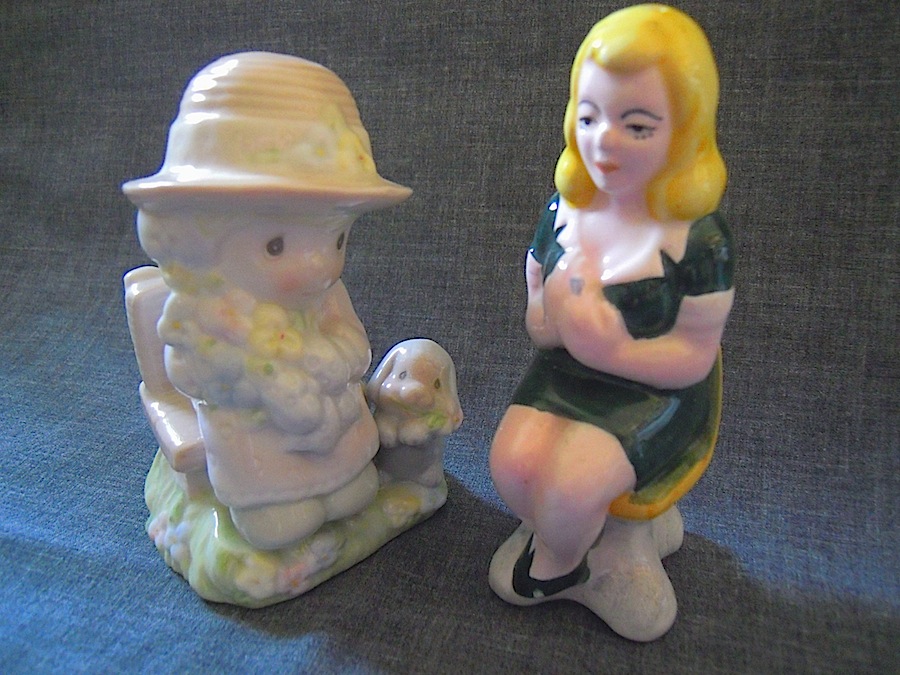
I bought the typist and her desk at a little shop in the Camden Passage antique market in Islington, near the Angel tube stop in London.  I was surprised to see her there, for I’ve looked for novelty salt-and-pepper shakers at various places in London and elsewhere in the UK, and never actually seen any.  I’ve assumed, then, that the novelty salt-and-pepper shaker set market was mostly restricted to Canada and the U.S–a North American phenomenon.   But if that’s the case, what was the typist doing on the wrong  side of the Atlantic?

Next question: what else goes with an office desk and a typewriter?
Precious in Pink

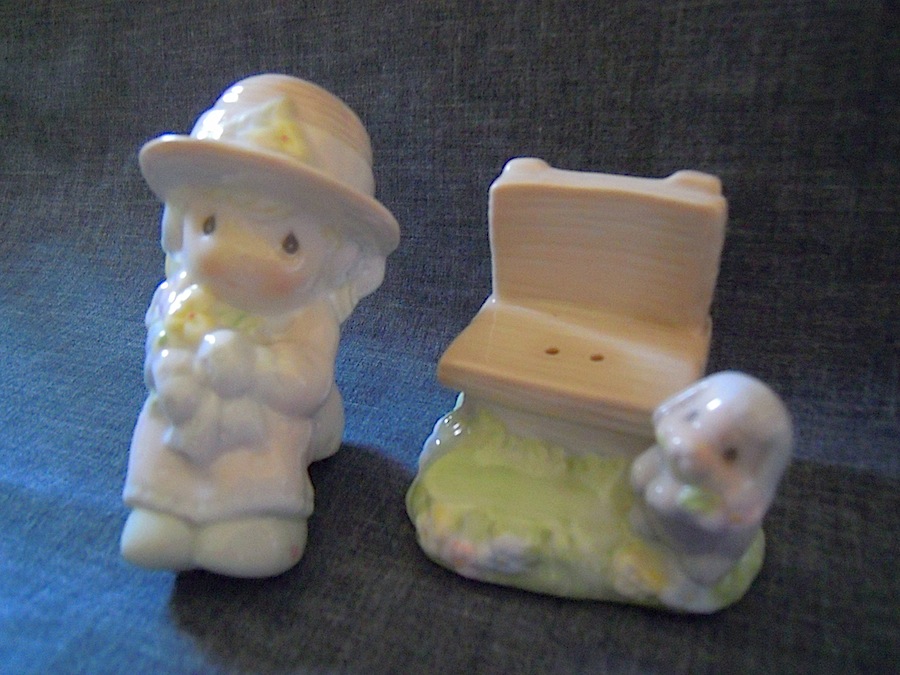
First, this time, we have a woman sitting beside a woman sitting: Each of the two ladies has a pet, one cat and one dog; and each holds something in her two hands: the cat, and I think (although it’s depicted quite vaguely), a bouquet of flowers.  This new sitting lady is so exceedingly and delicately pastel that it’s hard to make out many of the details that depict her–she has a nose, but a barely visible one, something more like a pimple.  She is, however, the essence of girlish innocence, with puffy delicate pink cheeks and winsome teardrop-shaped eyes and  a delicately and improbably pink little doggie who also carries some equally pink flowers.  The delicate pinks and baby blues actually make the pair of them look a little like nineteen-fifties bathroom decor–a lady-like ladies’ bathroom for sure.

So what does this sitting female go with?  the answer is, herself, for in this case, she and the bench she sits on are separate pieces:She, it seems, is the salt, and the bench, whose two holes are visible in this photo, is the pepper. And by the way, in case, anybody gets any ideas about something you sit in that can be a two-holer, no, this is clearly not a seat in an outhouse , and the girl is clearly not sitting on such a seat for the usual reasons people sit on them–although a quick first glance at the bench with the girl sitting atop, and the need for a large bundle of flowers, might suggest that).

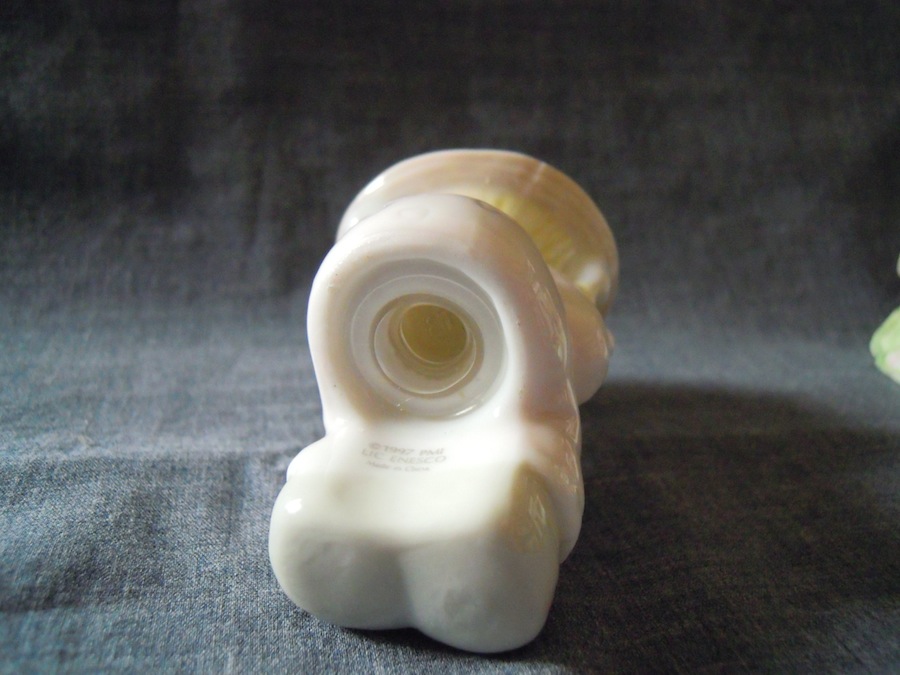
The way in which you insert the salt into the salt shaker might, however, make you stop and think a little:

Turned upside down, in fact, she actually does look a little like a toilet.

And I am leaving this frightening image before I am tempted to say unfortunate things about it involving words like hole and bottom.

But: as the last picture also reveals, this is one of the few salt-and-pepper shakers I have which announces its maker.  It claim a 1997 copyright by PMI, and also says “LIC ENESCO” and “Made in China.”  According to its website, “Enesco Canada Corporation, one of the most respected names in the Canadian giftware industry for more than 83 years, has been regarded as a leader in its field. Credited with being among the most innovative, trend-setting producers of gifts and collectibles, Enesco Canada continues its prominence throughout Canada.”   I also guessing from info on the Enesco website that PMI is probably an abbreviation for Precious Moments, Inc., a company dedicated to selling the artistic work of one Sam Butcher, who, according to its website, has “never lost touch with his original purpose to create art which combined his heartfelt emotions with his abiding faith.”  The company has now produced over 1500 pieces of its cute collectibles, each apparently with the trademark set of teardrop eyes, and a park based on them, Precious Moments Park in Carthage, Missouri, has almost half a million visitors every year.  So it seems I am in possession of a verifiable authentic collectible here–not just another chintzy novelty salt-and-pepper shaker set as I had thought, but a Way of Life.  A faith-based Way of Life at that.  I am looking at it with new, possibly teardrop-shaped eyes, and trying very hard to be thrilled or elevated or something.  Somehow, though, it still looks pink and round and chubby and noseless and begging much too hard for me to acknowledge its intensely adorable cuteness. just another cutesy shaker set after all.

One More Link in the Chain

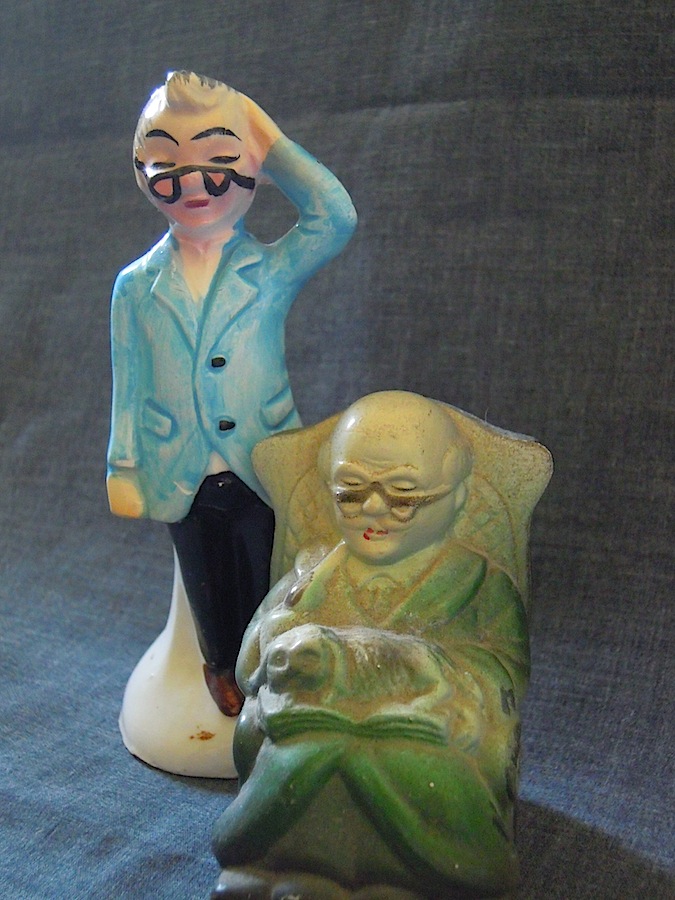
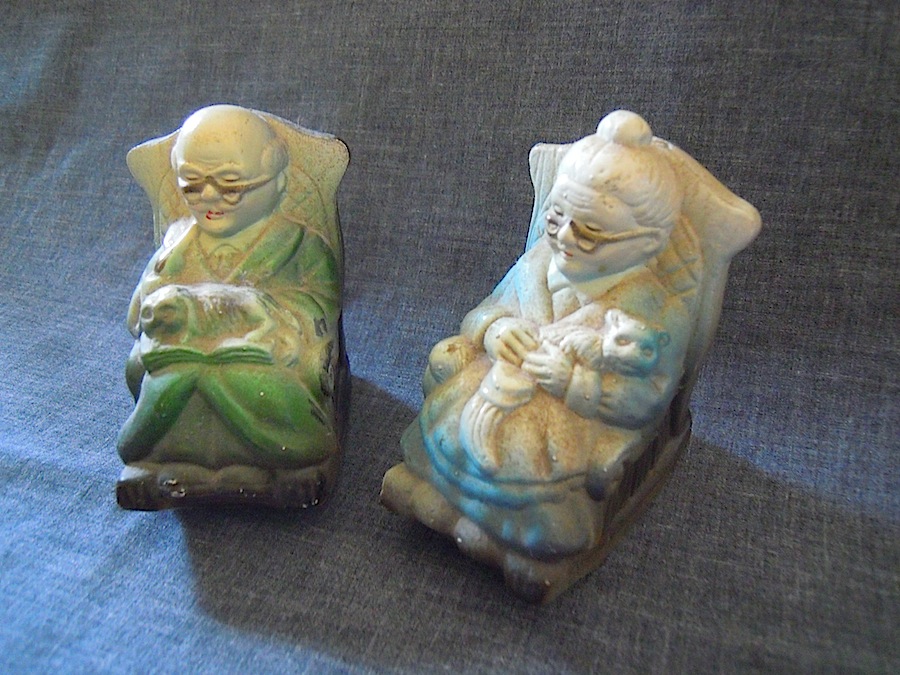
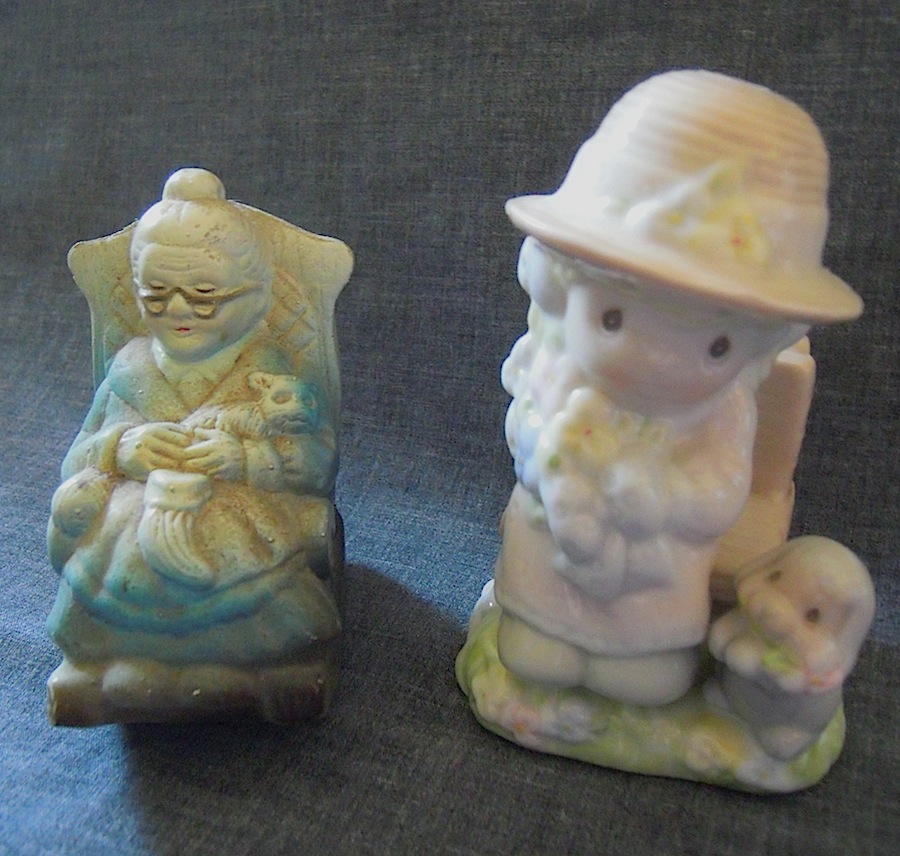
Last time around, I looked at an old woman who was in a relationship with an old man.  The old man now goes with, of course, another old man: This one is sitting on a rocking chair, apparently asleep, and with an animal, probably a dog even though it has owl-like eyes, asleep on top of the book he holds open on his lap.   He appears to have been sitting there asleep for some time, for he and his clothes and his chair all appear to be growing some sort of green mould.

So, now, what does the old man in the rocking chair go with?  What else but this?An old woman, also sitting in a rocker, also asleep, and with another animal asleep in her arms, this one probably a cat, although it has a tail more like a squirrel.  Her mould is blue.  I am suspecting that the mould is actually supposed to represent merely the colours of their housecoats; but in both cases it spreads creepily into their skin and hair, and thus creates something of a horror-movie effect, a kind of spreading plague–the dog and the cat are catching it, too.  Both the old man and the old woman wear the stereotypical glasses that can be peered over the top of, and thus help the pair to represent a satisfactorily recognizable caricature of what it means to be old.  Perhaps the plague is simply age itself, the process of growing into a mouldy oldie?  So much for

Grow old along with me!

The best is yet to be,

The last of life for which the first was made.

That’s a quote from Robert Browning’s poem “Rabbi ben Ezra”–which, intriguingly, goes on to say:

But I need, now as then,
Thee, God, who mouldest men.
Mouldest, eh?  Interesting.

While most of my salt and pepper shakers are made of some sort of earthenware, this pair is plastic.  Their bottoms inform me that they were made in Hong Kong.

Next question: what goes with an woman in a chair?

Once More for Old Times Sake

The chain of go-withs continues.  First an egg with a goose, then a goose with an old lady, and now, an old lady with . . what?

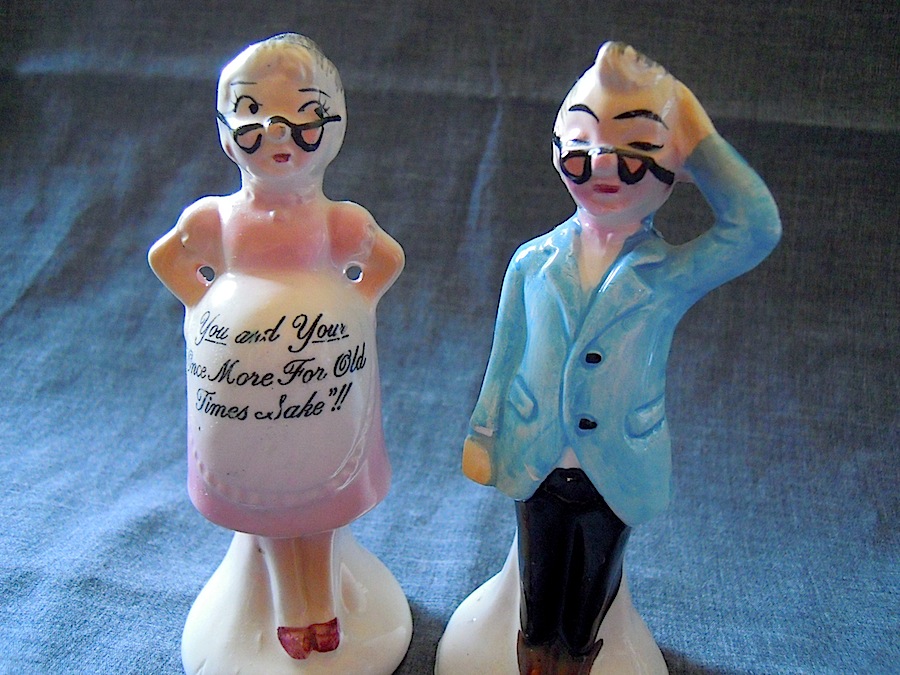
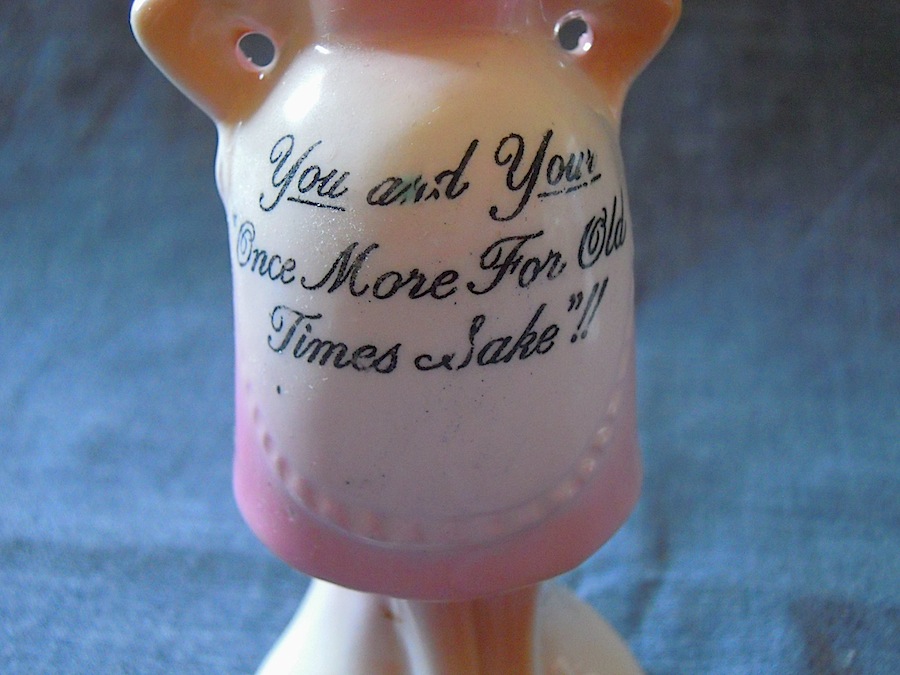
One old lady–no, let us say one mature lady–goes, first of all, with another mature lady:And then, one mature lady clearly goes with a mature gentleman.  Well, if you’ve read the lady’s apron, a not-really-all-that mature gentleman:If you’re mature enough to be having trouble reading the small print on the apron, this is what it says close up:“You and Your ‘One More For Old Times Sake'”!!

It’s a joke, see?  She’s a pregnant mature lady, see?  Sex still happens after the age of 35, see?  Hilarious, right?  As my own slightly immature parents used to say, “Laugh?  I thought I’d never start.”

On the evidence of my collection, salt-and-pepper shaker sets tend more toward the cute than the jokey; and when there are jokes, they tend, as here and as in the two sets of aboriginals with poems in what is supposedly hilariously ungrammatical English that I discuss here and here, they tend to be verbal rather than visual jokes.  I do, however, have a few other pairs that offer the kind of visual humour represented here by the mature lady’s large belly, which I’ll get around to discussing sometime soon, maybe.

Meanwhile:  it’s interesting how these two shakers evoke the advanced age of this couple by providing both of them, not only with the stereotypical huge glasses of old age, but also, by propping those huge glasses stereotypically below their eyes, so that they can both peer over them as old people in their far-sighted cynicism supposedly always do.  It’s also interesting in the context of this couple’s theoretical defiance of commonplace ideas about old people and sex that in spite of their daring rebelliousness, he still wears  conventionally masculine blue and she conventionally feminine pink–not to mention a typical old lady’s hair in a bun and an apron.  In salt-and-pepper world, stereotypes are forever.  And yet, still, and always, ever so cute, for despite the suggestive humour and the stereotypes, this couple is finally, more than anything, simply adorable.  And bound to have the cutest of cute babies.

What’s Good for the Goose?

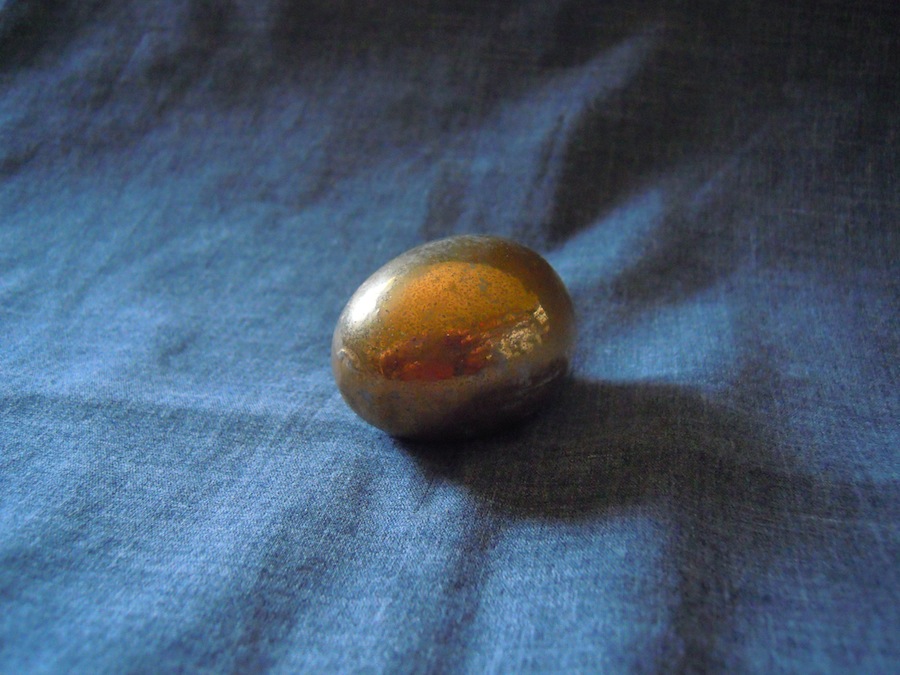
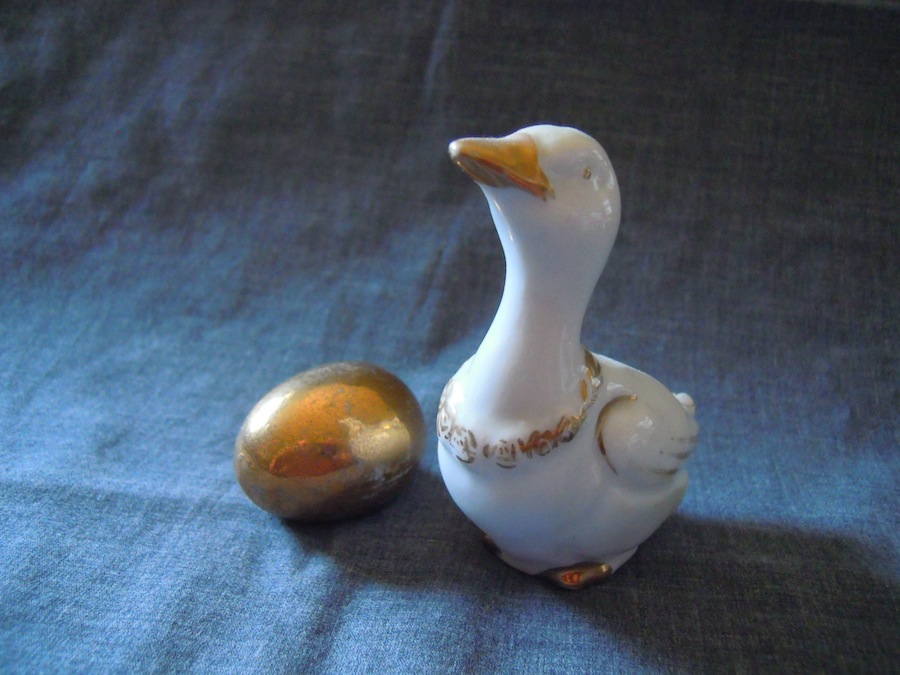
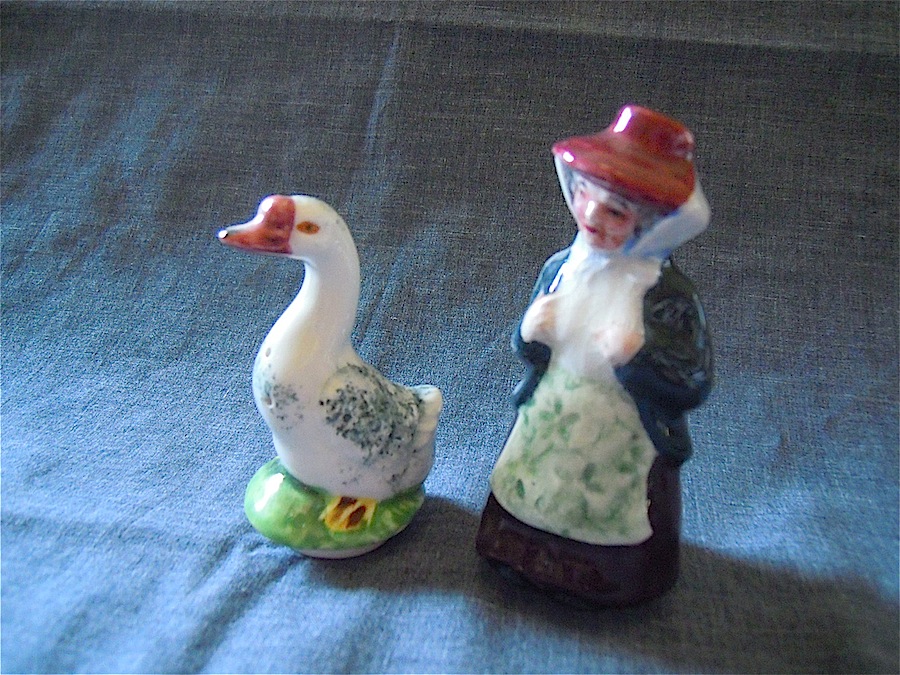
As was revealed in my last post , an egg, especially a golden one like this: goes with a goose: But then, what else does a goose go with?The answer of course, is an old woman–particularly, I suspect, the old woman known as Mother Goose:And so we have another interesting go-with, a goose and an old woman, two quite totally separate objects that have nothing to do with each other  except the linguistic convention that makes them a pair.  The implied knowledge that connects them even when they are so different is a kind of magic, I think.

Go-Withs

A lot of the sets of shakers in my collection are what the world of salt-and-pepper-set collectors, apparently, call “go-withs”–the ones I like to call binary opposites: the shakers depict two quite different objects that have some logical or linguistic collection to each other, like the common opposites of black and white or good and evil or adults and children, or for that matter, salt and pepper.  Take, for instance, this pair: The two shakers look nothing like each other, and so it might take a moment or two to figure out the puzzle:  it’s a goose and an egg, and geese lay eggs, and the egg is golden so, wait, I get it now, it’s the goose that laid the golden egg.  And considering the size of the goose and the size of the egg, it must have been really, really painful.

In the next series of posts here, I’m going to consider a series of go-withs in which one of each pair is also to be found in the next pair.  So now it’s a guessing game:  which of the goose or the egg will appear in my next post, and what will be paired with it?

And Now for Something Incompletely Different

These set appears to offer yet another set of racial stereotypes–but not, this time, aboriginal ones:The pitch-black skins, the big round eyes, the thick lips, the overall roundish dehumanizing cuteness–these are, it seems, a version of the standard classical caricature of people of African descent.  Much like the one in this old advertisement:Or like the traditional Golliwog:The figures on these shakers are just as offensively stereotyped as these old images are.

But I’m actually kind of hesitant about identifying the figures on the shakers as black stereotypes, for a couple of reasons.

First, the shakers have a kind of nautical feeling about them.  The figures appear to be wearing sailor hats, they are standing on what appear to be ship’s wheels, and the image on one of the shakers appears to be representing some kind of boat or ship.

But second, why do they represent ships–and why, for that matter, would they be representing people of colour–when they claim to be souvenirs of a place called Clyde, Alberta:I don’t know much about Clyde, Alberta, but I do know that it is a very small village north of Edmonton on the bald Canadian prairies–nowhere near a body of water where any sailors, especially any African-seeming ones, might ply their trade.  I asked my brother Joel, who lives not far from Clyde, if he knew of any nautical connection the place, or if he had any knowledge of its connection with sailing, and he told me this:

No idea.  Clyde is a really tiny village on the bald ass prairie.  They are primarily a farming community and they are slowly shrinking into a ghost town.
And I really have no idea why the sailor would be black.  Up until the recent influx of immigrants from Africa here in Edmonton, I don’t think there was ever an African American within 500 miles of the place.  A Ukrainian theme I might understand.  Perhaps some French Canadian.  But a black sailor – no idea.  Maybe they got a sale on discontinued salt shakers.  In that kind of small Alberta town – thrift I understand.

So perhaps it is just thrift.  After all, these shakers consist of various kinds of wooden beads and plastic buttons glued together–a kind of making something sort of useful out of leftover remnants, perhaps; what Claude Lévi-Strauss identifies as bricolage?

But then, I realize, there is a sort of seagoing connection, at least in the place name:  Clyde in Alberta might have been named after the river Clyde in Scotland, the banks of which  in and near Glasgow were the centre of the British shipbuilding industry for many decades.  So it’s possible to imagine some retired shipbuilder, perhaps very grimy from years of toil in the shipyards, being a founder of the town and memorialized here.  Or maybe a wealthy shipbuilder retired to Clyde and brought some of his former slaves along with him?  Or perhaps the stereotypically thrifty Scot who named the place got a good deal on leftover shakers from some town in Mississippi.  I don’t know.  And one way or the other, why are the sailors wearing pearl earrings?  Are they pirates?  Are theyAfrican-American  drag queen sailors lost on a spree in the wilds of Alberta?  It remains a mystery.

One other thing that I forgot to mention; the ships wheels on which the figure stand move sideways to reveal the holes the salt and pepper come from.  So these are a set of shakers with moveable parts–shakers moving into the category of toys, then.  I have just a few other pairs that move in various ways also.

A Different Pair of Binaries

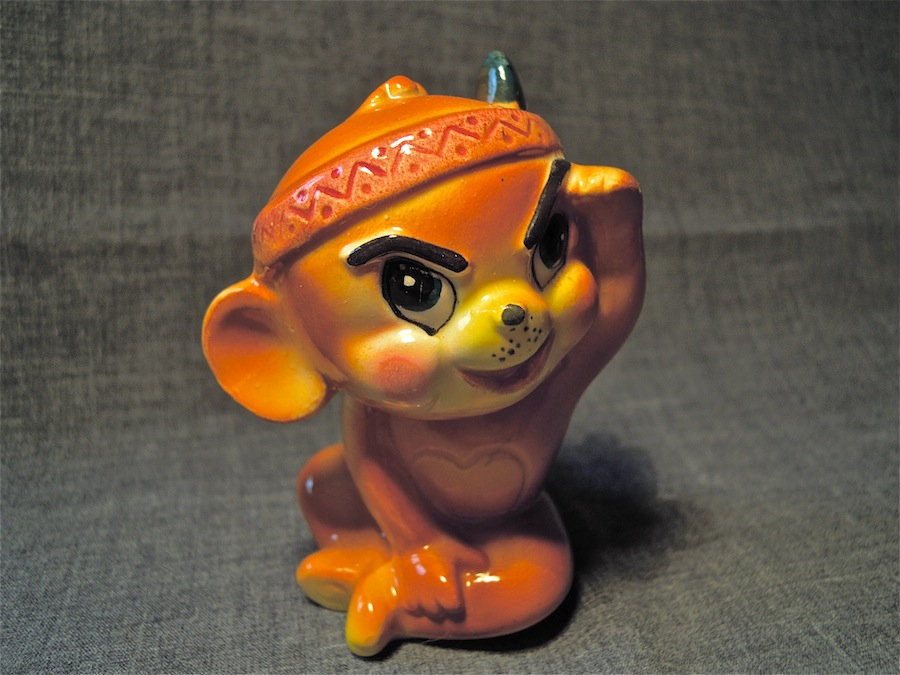
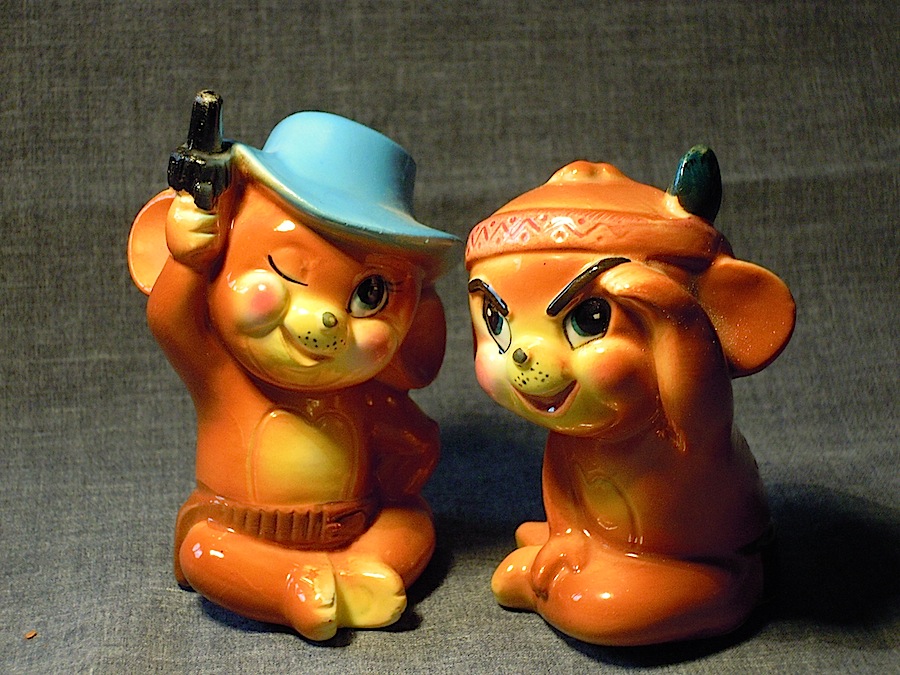
The aboriginal salt-and-pepper sets I’ve been describing in my latest group of posts are all gender-based.  They all consist of of one male and one female–or to be more accurate in the light of their indulgence is stereotypes, one cliché-type brave and one cliché-type squaw–the poem on the female of the pair I looked at in my last post even specifically identifies her as the “chief’s squaw.”   But this one is part of a different pair.  First off, he’s not human, but some kind of animal–a mouse, I think, but a mouse so entirely chubby-cheeked and cutesified that the actual species the shaker might claim to be representing remains a little uncertain.  Whatever else he is, though, he is cute–cute and aboriginal; you can tell he’s aboriginal by the headband with a feather in it (and also, a view from the back makes it clear that he is wearing a loincloth).  But this time, his partner is not an equally cute “squaw.”  Instead, we have this:Another mouse, but this one wears what looks like a cowboy hat and sports a pistol.  A cowboy and an Indian, then.  And most likely, two males.

What is most noticeable about them (beside the weird fact that even though they represent animals who have furry faces, their cheeks are nevertheless the cute rosy pink of an adorable human blush) is the devilish and mischievous look they share.  The Indian is either saluting or scouting, but in either case, he does so with a sly grin and arched brows.  The cowboy winks slyly as he shoots into the sky.  Neither looks very trustworthy.  Both imply something transgressive–the kind of defiantly uncivilized boyishness that used to be associated with various frontiers, perhaps, as in Frederick Jackson Turner‘s frontier thesis.   As Huck Finn says at the end of Mark Twai ‘s novel,

 I reckon I got to light out for the Territory ahead of the rest, because Aunt Sally she’s going to adopt me and sivilize me, and I can’t stand it. I been there before.

At any rate, this set of shakers seem to be more like compadres than enemies, more Tonto and the Lone Ranger  than the Whitehats against the Redskins. Once more, the racist stereotype seems to insinuating itself into allowability by being harmlessly cute, like a bad but adorable little boy saying bad words or wearying his muddy boots into the house.

More Wooden Verse

Here’s another set of aboriginal stereotypes, drawn on pieces of wood with some of their bark still attached, and described in some even more wooden verse.  The usual markers, by now readily recognizable, are present: the hooked noses, the war bonnet, the headband, the braids.  The wooden poems, not so readily readable from the photos, go like thus:

Him not big chief

By default, him

Big chief cause

Him use salt.

And:

Her not chief’s squaw

Cause she pretty

Her use much pepper

She very witty

Note the bad grammar and the lack of reason: why would you choose the person who used the most salt as your leader?  In what way is using a lot of pepper to be identified with wit?  I mean, I’ve heard of salty humour, but peppery?

I suspect these are trying to be funny, the humour stemming from the supposed ignorant ungrammaticality of natives, and I guess, the silliness of their ideas about salt and pepper.  But it’s hard to believe that very much thought or effort went into dreaming up these poems.  It’s a kind of lazy humour, then, the knd you fall into when you just coast on cliches and stereotypes and aren’t actually trying very hard–or are actually trying very hard but don’t possess the pepper, I mean wit.  The sad and telling part is how often that kind of lazy person’s wit reaches so readily and automatically into the world of racist slurs.  If you can’t come up with anything else, you can always say a few familiar cruel things about minorities.

Like a surprisingly number of my salt-and-pepper sets that claim to represent a place, this one claims to reveal the spirit of Banff.  I don’t know why I have so many Banff sets–maybe it’s just because it’s a big centre of tourism and therefore there was a market for a lot of kitsch, including a wide variety of novelty salt-and-pepper shaker sets.

Poetic Racism

At first glance, if you approach them from the right angle, this set of shakers looks like a couple of pieces cut from a small branch of a tree. But turn them around, and they look quite different.

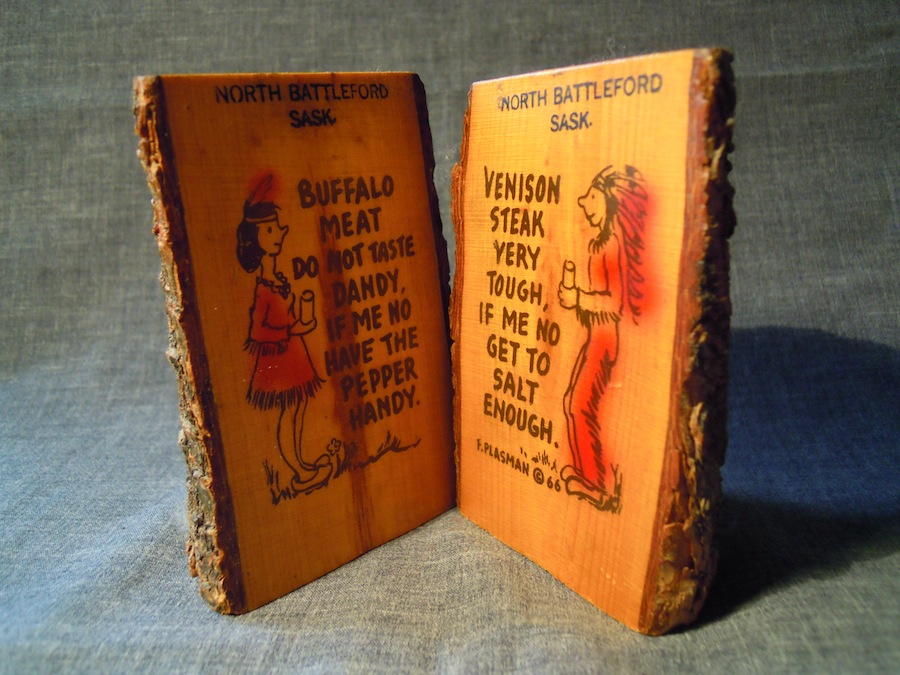
Yes, that’s right, another couple of Indian stereotypes.  While this pair are only drawn in two-dimensions and not three-dimensional figures, they share many of the usual markers of aboriginality: she with her single feather, he with his war bonnet; the fringed outfits, the dark hair, the prominent noses.  Also, this time, they accompany a poem.

Not only a poem, but apparently, a copyrighted poem, according to the information on the salt.  Not only a poem, but a poem that purports to represent the ignorantly ungrammatical speech patterns of stereotyped natives.  Me no likum.  Me no likum at all.

This set of shakers is not only made of wood, but it seems that they have been made of an actual hollowed out and bark-covered piece of wood–the bark is authentic. It seems to be, maybe, pine?  The only F. Plasman I can find on the internet is the name of a bakery and tearoom in Den Haag in the Netherlands, where I’m fairly certain buffalo meat and venison steak aren’t often on the menu.

This indigenous couple is a souvenir of North Battleford, Saskatchewan.