Continuing the theme of stereotypes of people of African descent, there is this pair: Since the human of this pair is wearing what looks sort of like a grass skirt, wielding a club, and accompanied by a lion rather than by a pancake-wielding woman, I presume he is supposed to represent, not an African American, but just an African period. He has, nevertheless, the same old fat red lips and round black eyes. The stereotype transcends national and even continental borders, it seems. And it’s interesting that it should be a lion accompanying him. They are either, or both, a hunter and what he hunts, or two equally savage, equally animal-like beings. Note, however, that both exude a form of cuteness, the hunter seeming, despite his club, sort of sweet and wide-eyed and adorable, and the lion doing his best to look dangerous with a strange sort of cutesy smirk. They are another good example of danger depicted but contained and diminished, made to seem merely cute and harmless.
And hey, what else could they be when they come, from of all places, Banff? That right, Banff, Alberta, Canada, the resort in the Canadian Rockies–home of snow and skiing. Now what exactly a scantily-clothed African tribesman and a tropical beast of prey have to do with Banff I do not know. But I’ve already reported in earlier posts on other strange souvenirs from Banff: a pair of ungrammatical aboriginals, and a pair of golden hands. It begins to seem that when it comes to souvenir salt and pepper shakers, almost anything will do to represent a ski resort in the Rockies.
These fellows make no sense to me at all:They are, clearly another pair of black stereotypes–they have the usual thick red lips and round white eyes, a la the Aunt Jemima of my last few posts. But they are not, this time, African American stereotypes, or if they are I have no idea about why they might have climbed on top of a pair of what appear to be Chinese cabbages. Is it some sort of cabbage race? Are the vegetable-like things they are climbing on meant to be Sui Choy, or are they some stubby form of Bok Choy? Are the human figures on the vegetables meant to be Indians or Sri Lankans, perhaps? Why else are they reclining on Asian vegetables? Might they be African boat people on a slow boat to China? I have a feeling there is possibly a bug metaphor in play–but it’s just a feeling. So this is another pair which remain a strange mystery to me. Someone apparently thought there was a market for these, an audience that knew some phrase or something through the lens of which which they could view these shakers. I am not in that audience. If anyone who is could give a hand, I’d be grateful.
In my last post, I discussed Tavia Nyong’o’s idea that “the shiny, hard, and brittle surfaces of racist ceramic figurines reflect back upon the psychology of scapegoating black children”–a view of “blackness as a hardened form of subjectivity.” Nyong’o calls it, “this racial simile, a black skin is as hard as stone; not skin at all, but a mask, with perhaps nothing behind it.” For her, “This invulnerability provides an alibi for racist violence.” As a result, ceramic figures like my Aunt Jemima and Uncle Mose invite or encourage some form of that violence–either actual or emotional–in their implied prejudiced non-African-American viewers, and the complex response of disgust and shame that Nyong’o identifies as likely in their African American viewers.
My own skin is not black. But when I look at hard black objects like my Aunt Jemima and Uncle Mose, I feel no immediate sense that it would be fun to give them a quick punch or two, or acceptable to maybe drop them on the floor, unless as a negative response to what they represent. As I’ve suggested earlier, my response to them is to share some of the disgust that Nyong’o describes–but not, clearly, because I identify with what they represent. They are not black like me, or rather, I am not black like them. My disgust is that of an outsider, then, and any shame I might feel is merely theoretical, impersonal. And maybe a little too easy, therefore?
In an attempt to get my mind around the potential positive value of that shame response that Nyong’o describes, I find myself wondering if there are equally hard ceramic shakers in my collection that might be inviting me to a more immediate identification with them, and if so, how I felt about that.
First, do the hard ceramics that most of my shakers consist of equally convey messages of their symbolic hardness, of the ability of the objects they depict to take punishment? Looking over my shelves, I’ve decided that they do–especially the racial stereotypes and the cute children and animals. A crime is being committed against them. a slanderous misrepresentation that dehumanizes them–hardens them as the material that represents them hardens them. The responses of silliness or defenceless cuteness they invite then also invite a view of the kinds of people and animals they depict as sort of acceptably powerless, acceptable as the butts of hostile jokes or the dehumanizing eye of cuteness. They are, in fact, all quite deeply insulting.
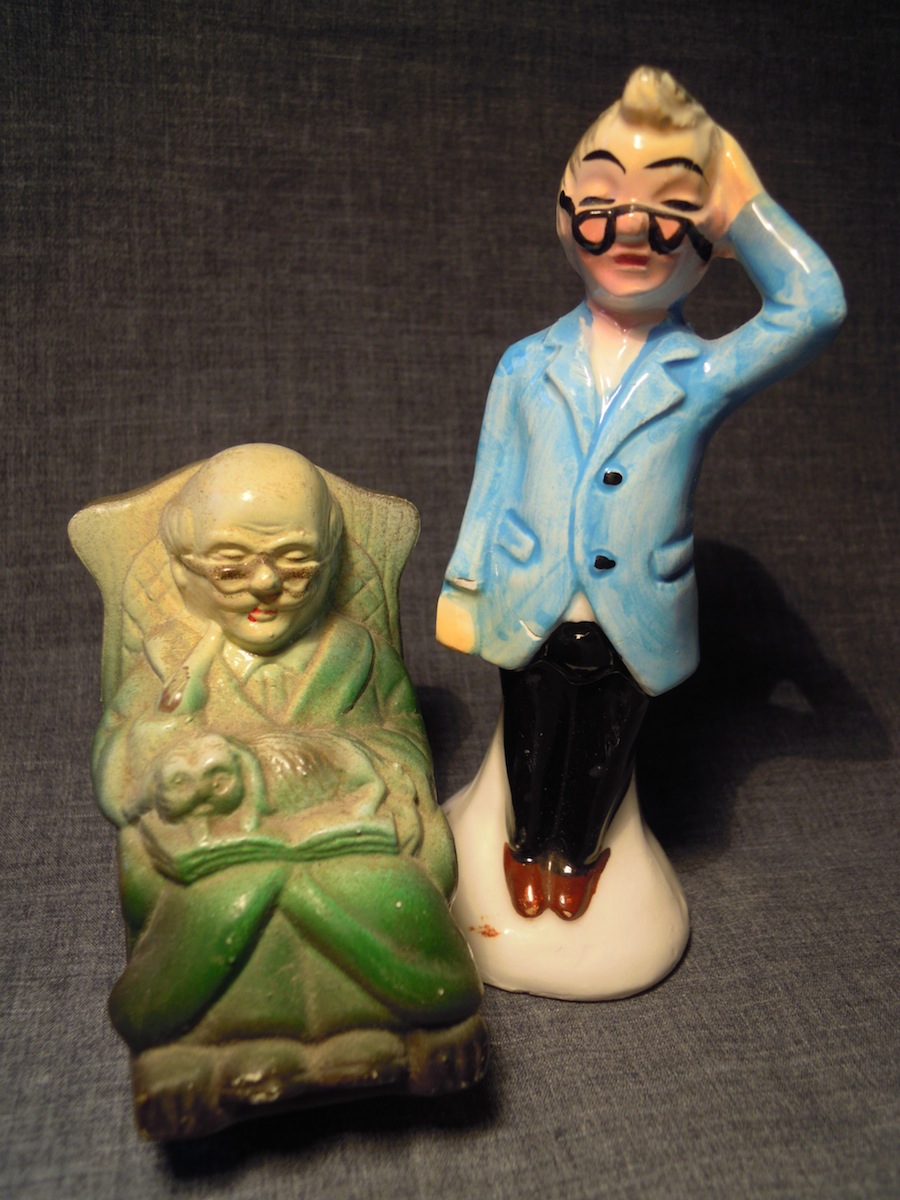
And so, are any of them insulting to people like me? Is there something I should feel particularly insulted by? I decided I am old enough to recognize that the shakers in my collection that represent people most like me are these two:Two old men. Two hard old men–one hard earthenware, the other, hard plastic. Very shiny old men, with a shininess that implies a slick hard surface, and very much empty of any real humanity: both of them engage stereotypes about what it means to be old, weak, rather sexless, sleepy, nearsighted, confused. Both ask me to think of people like myself as powerless and pretty weak and maybe kind of cute and adorable for that reason–i.e., harmless. Both invite their viewers to see real old men like me as these figures depict them–as safe subjects of stereotyping and stereotypical jokes. Both imply that old men like me are hard enough, i.e., dense enough, weak enough in our dehumanizing and desensitizing and stupid-making old age to be able to take the abuse, to be perceived as what these jokey representations insist we old men always are.
And do I then feel the sort of shame for being old enough to recognize that these figures are claiming to represent people like me that, as Nyong’o says of the black ceramic figures that represent people like her and therefore arouse “the idea that ‘I am thought of as less than human’: “the very shame that floods through at that thought, a shame that, were we not human, we would have no capacity to feel, is our best internal evidence that the thought is wrong and vulgar: I feel (shame), therefore I am (human).” And as much as I want just to say that we old men are not all or only weak, not only the dehumanized remnants of their former virile selves that these hardhearted shakers depict, I also have to admit that it shames me that I know that the strangers who pass my old face and body on the street are thinking of me in exactly these shameful and shame-inducing ways. It makes me feel something a little like what the old woman in Randall Jarrell’s poem “Next Day” feels, albeit in a less gender-inflected form:
Now that I’m old, my wish
Is womanish:
That the boy putting groceries in my car
See me. It bewilders me he doesn’t see me.
For so many years
I was good enough to eat.
Well, maybe I was never good enough to eat–but I was at least visible as something other, something more specific than just another stereotyped old man.
So I think I get it, that shame response–and I think I see how evoking it can have the positive effect of reaffirming the humanity that objects like these shakers are in the process of denying. Oppositional curating might just work after all.
Looking for some ways of thinking about collections of objects of which one takes a less than purely sympathetic view–the one being me and the objects being my salt and pepper shakers–I came across “Racial Kitsch and Black Performance,” an insightful article by Tavia Nyong’o (Yale Journal of Criticism 15.2 [Fall 2002]: 371-3910. The “racial kitsch” Nyong’o focuses on includes stereotypical representations of African Americans like the Aunt Jemima and Uncle Mose shakers I discussed in my last post.
Aunt Jemima and Uncle Mose
Speaking of negative responses to such objects, she says, “Racist kitsch is pretty disgusting. … Through disgust, we reassert our dignity and attain distance from the pleasure that the stereotype urges upon us. . . .Our disgust tells us that we are not the audience solicited by the object.” So far so good; I can see how my negative responses to these ugly stereotypes allows me to excuse myself from the intended audience–but then, still, why do I collect them and keep them around me?
Some theorists Nyong’o refers to probably would think I shouldn’t; she reports that Robin Chandler identifies racist kitsch as simply “visual terrorism,” and that Michael Harris suggests that, because such kitsch “is linked to, and a product of, white imagination,” the “attempt to invert and reconstruct another’s dreams inevitably keeps one tied to and preoccupied with that other rather than the self.” As the kind of person who would most likely be identified as being “white,” I can’t easily claim to actually be separate from the white imagination that has so othered those of a different complexion; and yet I do feel–and do very much want to feel– other than that specific sort of racist white imagination. Even so, if these theorists are right, my collection, which I like to proclaim represents my ironic response to the ugly stereotypes it contains–my preservation of them in the context of a deep awareness of how they represents values I don’t share–fails to ironize successfully. In what Nyong’o might call my “oppositional curating” of the collection, I am confirming the power of the stereotypes even while and by means of the act of viewing them through my lens of critique and irony. They win just by continuing to be what they are and therefore even and especially in my insistence on attacking what they are and continue to be because they continue to have the power to attract my ire and thus need to be attacked.
Nyong’o herself builds on that idea by offering an even more extreme version of it:
What would be the consequence if an examination of such strategies of oppositional curating and ownership unexpectedly revealed that one key characteristic of the racist figure was its ability to retain, even under the powerfully revisionary gaze of disgust, the capacity to act as a scapegoat or effigy? Could it be the case that our oppositional gaze and attendant practices depend upon the effigy’s characteristic talent for absorbing blame, and thus, that they perpetuate our dependence upon scapegoating and its attendant cruelties?
In other words: responding to the African American stereotyping of my Aunt Jemima shakers by blaming them for the racism they express is merely confirming the conventional assumption that what is African American is that which can be safely blamed and attacked. The object continues to successfully represent the racist stereotype even in my act of using it in an attempt to attack such stereotypes–indeed, does so as as a result my presumption in choosing to so act against it. As Nyong’o says, then, “oppositional spectatorship to the figure of racist kitsch cannot overcome its ability to reproduce scapegoating, because these practices of opposition inevitably reinscribe the object as a target for hatred and scorn, and in doing so, draw other people into the suffering orbit of the ceramic doll.” Hating the figure is just another version, and thus a recapitulation, of hating the people the figure purports to represent and invites derisive, hateful responses to.
But Nyong’o also suggests another possibility. She says,
At bottom, the shame of racist kitsch resides in the idea that ‘I am thought of as less than human.’ And yet, the very shame that floods through at that thought, a shame that, were we not human, we would have no capacity to feel, is our best internal evidence that the thought is wrong and vulgar: I feel (shame), therefore I am (human).
She argues, then, for “acknowledging the permanence of our shame, and its usefulness . . .to locate, within the transformations of our shame, a way out of scapegoating.” In a weird way, then, she invites an identification with objects of racial kitsch as that which, by claiming to represent people like her, evokes in her a sense of shame for being so represented that itself marks her difference from what shames her–for it itself, a hard ceramic object, can feel no shame.
It can feel no shame in part because it is a hard object, its material hardness successfully evoking or inventing the hardness of what it represents: a kind of semi-human that is too little actually human to suffer, to feel pain, that is hard enough to withstand the ill treatment necessary at first for these enslaved and then for those who have been and still are all too often viewed as racially inferior: “The shiny, hard, and brittle surfaces of racist ceramic figurines reflect back upon the psychology of scapegoating black children. . . . blackness as a hardened form of subjectivity.” As understood in terms of “this racial simile, a black skin is as hard as stone; not skin at all, but a mask, with perhaps nothing behind it. This in- vulnerability provides an alibi for racist violence.”
I have a lot more to say doubt this symbolic hardness, and how it might apply to novelty salt and pepper shakers more generally. Continued in my next post.
In previous posts, back in March, I tried to come to grips with my responses to the sets of shakers in my collection that depict Native North Americans. I began by saying of one pair that “It’s that rendering of the toxic as perfectly harmless that most fascinates me about them.” Later, I described a set representing aboriginal children as “too cute to be offensive, surely–unless we start think about how offensive it is to make them so cute, so harmless, so barely human.” My basic response, then, was a squeamish revulsion to the dehumanization of the subjects these shakers supposedly represented, a squeamishness that seemed to be being deflected by the miniaturized cuteness and Edenic shininess of the depictions.
I have that response in an even more intense way to a shaker set representing a different racial stereotype:
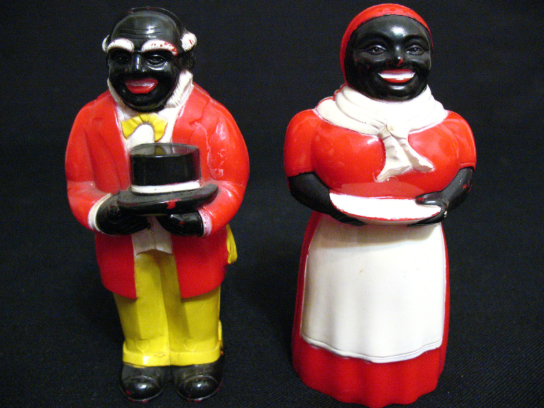
Aunt Jemima and Uncle Mose
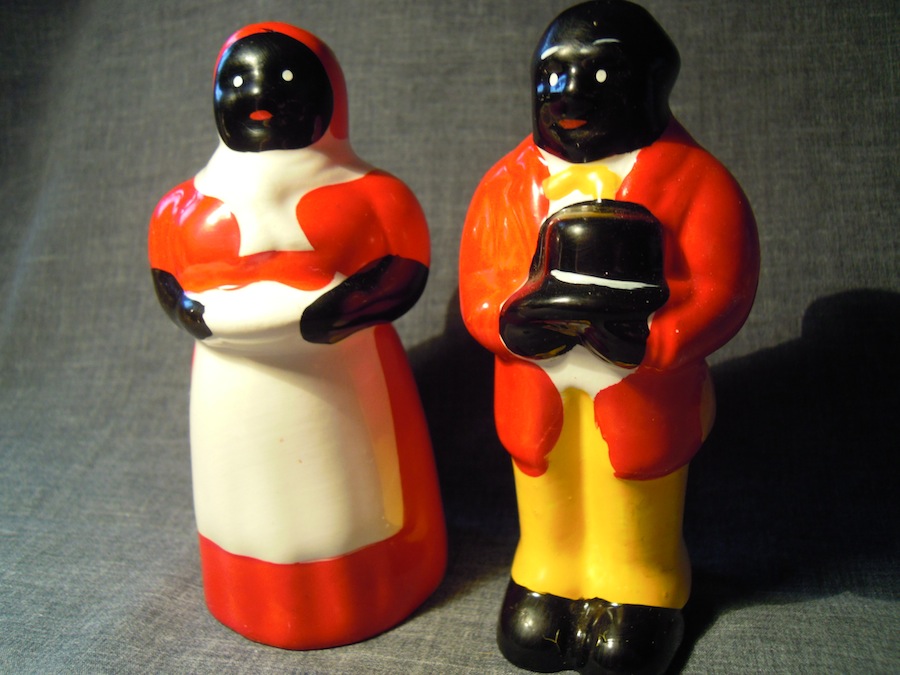
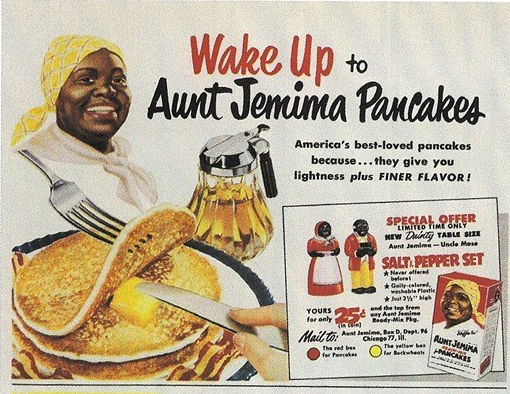
This is a version in highly glossy earthenware of two characters out of advertising lore: Aunt Jemima, who has been the public (albeit changing) face of a manufacturer of ready-made pancake mixes and pancake syrups for well over a century, and, as represented in paper dolls and other ephemera produced by the pancake company, her husband, Uncle Mose. In fact, this set was at one time sold by the pancake mix company.
Aunt Jemima and Uncle Mose Shakers on Offer from the Company in the Nineteen-Fifties
They are an entirely obsequious pair, she offering up what might a plate of pancakes tucked under her capacious bosom, he with his hat in the hand and happy to oblige.
This is a particularly crude version of this happy pair; others found on various auctions sites and collector’s pages on the internet show them with more clearly defined facial features, and with the plate of pancakes more obviously a plate.
But the crude broad strokes of their depiction in my set of shakers merely offers a slightly more obvious and exaggerated version of the stereotypes these characters always represent–and as such, a paradigmatic version of the essential and essentializing African American stereotype: a dark brown face with white dots for eyes and a broad hump for a nose and a bright red line for lips. These features are so generic that the only difference between Aunt Jemima’s face and Uncle Mose’s in my set is the white lines outlining his eyebrows. This is the stereotype in shorthand–a few broad strikes that act less as reminders of the kind of people they supposedly depict than as reminders of the already circulating and taken-for-granted stereotypes of such people. They are cartoons of cartoons.
So what is the stereotype, then? What does it want us to think about African Americans as a type? First, obviously, there ARE a type, a separate class of human beings from the intended audience of white folk who presumably produce and collect such objects, and clearly, given their barebones typicality and ability to be so readily summed up in such a clear and simple way, an inferior class. Can you imagine a pair of shakers that could so successfully and completely conjure up an image of white stereotypicality? I can’t. We whites are, it seems too human to be stereotyped in terms of our whiteness. We have to resort to other aspects foo our being than our skin colour–our gender, our occupation, our sexuality, our age–to conjure up suitable generalizing and dehumanizing stereotypes.
Beyond that, as not just African American but two specific African Americans characters, Jemima and Mose are, as depicted here, almost aggressively over-assertive images of bright happiness, a world without shadows. They wear bright red and bright white and bright yellow–no subtle or gloomy shades for them (except, of course, their skin, which is what has consigned them to this exclusively happy state of manic bright colourfulness in the first place). They are also, clearly, loving and loveable servants, obedient and obliging, nostalgic reminders of the supposedly good old days in the Old South where servants were happy to serve, and indeed, as we all know, slaves were ecstatically happy to be slaves. Slaves to white folks, of course: the image of Aunt Jemima not only implies the down-home goodness of processed foods–if she represents them, they must be just like the ones that professional home cooks used to make back in the good old days–but also, the extent to which taking advantage of the pre-processing and buying the pancake mix is going to be something sort of like having your own slave in your own kitchen.
I still haven’t come to grips with why I spend my money on these noxious things and put them in display in my home. I understand that those who forget about history might be doomed to repeat it–but i wonder if remembering it with figures like these might be an act of repeating it anyway. But I’ve been reading some theoretical discourse on that subject lately, and I plan to report on it in my next post.
As I was suggesting in my last post, the range of possible go-withs for any specific shaker is as large as the linguistic ingenuity and/or cultural repertoire of its manufacturer. Consider dogs: We are already familiar with the territory-marking little fellow on the left, happily claiming ownership of the somewhat damaged fellow on the right (note how his paws have been clumsily reattached by some owner prior to myself). We know the peeing one went with a fire hydrant–so what else might a dog go with?
Some possibilities that occur to me:
a cat
a bone
a home, as in Lassie Come Home
Flanders, as in A Dog of Flanders
a bowl of kibble
a dog trainer (and this one is, after all, nicely sitting)
a blind person
a narcotics officer at a luggage carrel in an airport
a doghouse
fleas
a stick (the kind you throw)
a dead lion ( Ecclesiastes 9:4-5: “a living dog is better than a dead lion.”
a bitten man
a mechanical rabbit
some vomit to be lapped up (old saying: “a dog returns to its vomit.”)
The King, as in Pope’s “I am His Highness’ dog at Kew/Pray tell me, sir, whose dog are you?”
another dog
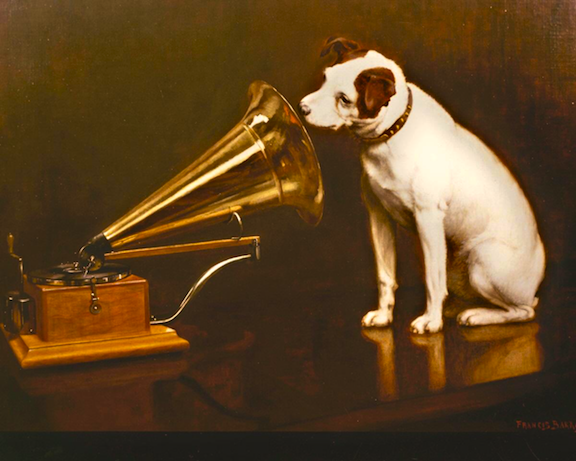
But in fact, none of the above. This dog goes with something else altogether:It is, then, a version of the RCA Victor dog, the one that appeared for many decades on the labels of phonograph records, along wit the slogan “His Master’s Voice”:
This image was originally based on an 1899 painting by Francis Barraud:
So in this case, then, a dog goes with an invisible master’s unheard voice, circulated as an endearingly cute image in popular culture. Seeing either the dog or the gramophone on its own is not likely for most people, I think, to evoke the idea of the other; every dog does not deserve its gramophone, or vice versa. But together, their being together seems totally obvious.
I’ve been thinking further about the tyranny of pairs in the world of shaker sets, which I discussed in my last post. It has occurred to me now that it’s the implied connection of the two disparate things in a pair that is, often, the source of the comedy or even the cuteness. A dog and a fire hydrant–but of course they go together. How funny. How cute. A drunk and a lamp-post. How funny. How cute. Or, heading backwards through the history of other shaker sets I’ve discussed on this blog earlier: a lobster cooking itself in a lobster pot, a buttock and another buttock, a female body and a pair of separable breasts, a mouse and a piece of cheese, an angry worker and a broken computer terminal. All funny. All cute. In each case, the single shakers go with something else that might not be the first thing you’d expect, but, once you get it, you get why it’s connected to the first thing in a cute or funny way. It’s the sort-of unexpectedness of what, in the long run, is pretty expectable, but not to begin with totally obvious–a connection between two separate and quite different things that nevertheless satisfactorily and convincingly ties them together, by means of references to old sayings, old jokes, old ideas about stereotypes. While the two separate things remain separate they are nevertheless connected, by means of language and the network of cultural repertoire they refer to and pass on.
Out on the street, you can find, as well as street signs, the occasional fire hydrant:And along with a fire hydrant, you will usually find . . . ? A fireman, perhaps? No. A group of children getting a free drink on a hot summer day? No. What a fire hydrant goes with, of course, is a stream of running liquid:The liquid, in this particular example, emerges not from the hydrant itself, but from the animal who is not only making use of the hydrant as an eliminatory convenience, but also, letting others of its kind know it has been there. Or in other words, a fire hydrant goes with a peeing dog:
What intrigues me here, as with so many of these go-withs, is the impeccable logic that clearly joins two things together, even though a first glance at one or the other of them would not likely have automatically or even very quickly evoked the other as an obvious accompaniment. Honestly, when I look at a hydrant I do not automatically think about dogs (although perhaps I might have if I sent more time looking at old cartoons–for I guess this is yet another cartoon cliché, a true go-with for the drunk and the lamp-post).
At any rate, the practice of viewing the world through the paradigm of salt and pepper, this and that, go-with and go-with, both creates strange bedfellows, matching pairs, and imposes a persuasive logic of pairness: the bedfellows may be strange, but obviously, since they are together, they do and must belong together, each the most obvious and most logical companion for the other. Of course a dog goes with a hydrant. What could be more obvious? And not because both emit streams of running liquid, but because one is a salt and one is a pepper, and they are sitting beside each other, and that’s that.
Some of the more interesting sets of salt and pepper shakers I’ve seen in antique shops are ones that are not in fact, clearly sets–or at least were not necessarily designed to be the sets they now are being sold as. Not surprisingly, for salt-and-peppers consist of two objects that are in fact physically detached from each other. It’s quite possible, then, that one of the two might break, or that the two might end up somehow separated from each other–a result of a nasty divorce settlement, perhaps, or a simple error in packing when a roommate leaves, or a salt incorrectly grabbed up along with the remains of dinner and thrown in the garbage, while it’s now sadly lonely pepper partner remains behind. What more obvious thing for a store owner to do when such a sad single shows up in the shop but to find some other woeful isolate that might by some stretch of the imagination be considered to go with it, and try to sell them as a pair? And lo, as if by magic, they do, sort of become a pair, as would-be purchasers like me look at them and, more or less inevitably, I think, try to decide what is the intended connection between these two objects now identified on their sales tag as a pair.
The paradigm of the pair is powerful. It can join what some man (or woman or child) has put asunder. In the shaker universe, linguistic binarism rules.
We continue the go-with chain with what appears to be another pugnacious guy, all ready to return the blow being struck by the enraged data-entry fellow of the last post:
But why, you might ask, if he has his dukes up and is all ready to fight, is he sitting on the ground? The answer becomes clear as we view what he does actually go with:
He is actually, it now becomes clear, a rather drunk man-about-town, the town apparently being New Orleans, the street being Bourbon Street, the condition being, too sozzled to be able to stand up. In other words, this drunk goes, not with the traditional lamppost of cartoon cliché, but a street sign. I suppose that makes him a souvenir of Bourbon, the major tourist attraction of New Orleans–not just the street but the controlled substance.
Meanwhile, I’ve been trolling the internet looking for an example of the classic drunk-hanging-onto-a-lamp-post cartoon–and I can’t find very many. Apparently it isn’t as classic as I thought it was. The drunk with a lamp-post seems to be most popular around the internet these days in three jokes:
A drunk loses the keys to his house and is looking for them under a lamppost. A policeman comes over and asks what he’s doing.
“I’m looking for my keys” he says. “I lost them over there”.
The policeman looks puzzled. “Then why are you looking for them all the way over here?”
“Because the light is so much better”.
And:
Statistics in the hands of an engineer are like a lamp-post to a drunk–they’re used more for support than illumination.
And:
A drunk leaning against a lamppost stares up at a signboard and yells, “It can’t be done, it’s too big!”
Another drunk staggers by and asks, “What can’t be done?”
The first drunk answers, “That sign says, ‘DRINK CANADA DRY.’ “It’s just too damn big, it can’t be done!”
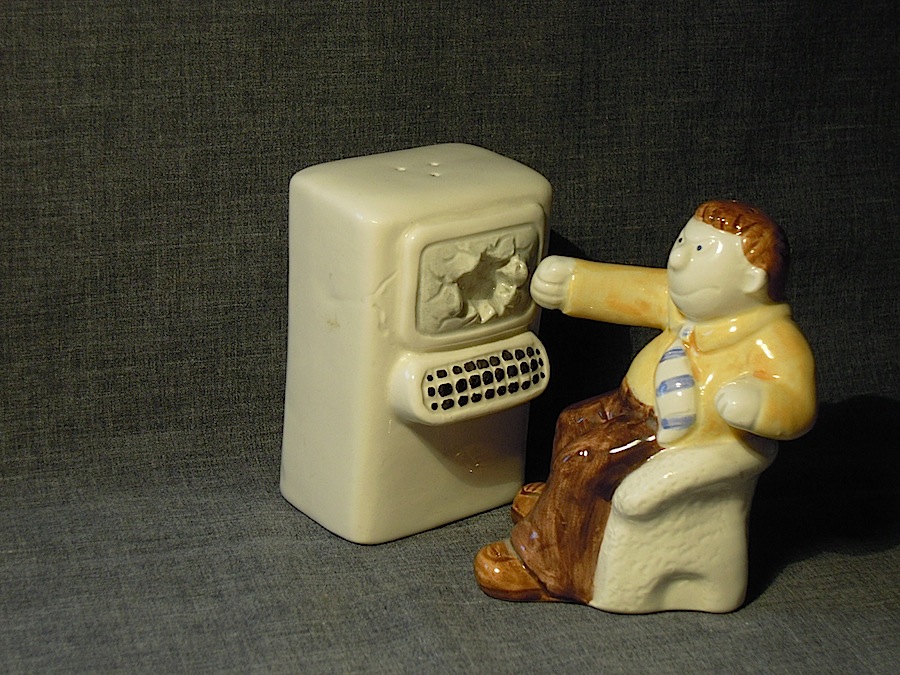
This is a bit of a cheat, maybe. The typewriter on a desk, I now declare, goes with . . . a computer terminal: Well, it has a keyboard, right? And it’s sort of like a desk. You sit at it while working, right? Or at least, you used to do so, in an earlier world of bulkier computer terminals. It is certainly a work station, because what it actually goes with is the man who sits in front of it, and whom, apparently, is in the process of giving in to his urge to punish it for what it makes him do all day: The man is looking suitably enraged as he smashes his fist into the screen. It is a mighty punch, as can be seen when you turn the computer terminal around: the blow has gone all the way through to the back:
This, like the set I posted about earlier revealing the results of mature people enjoying “One More Time” is a visual joke. When I was first given this set, I thought it might be a guy having bad luck with a gambling machine–but this terminal looks much too business-like for that, as does the man’s tie. It has to be work-related rage. Interesting, then, that the two shaker sets I have that represent life in the business world of offices should both depict people who clearly hate their jobs. And one of them has actually done something about it. Something pretty drastic.
And note that once more, as with the tomahawk-bearing aboriginals I discussed in earlier posts, the hostility and threatening danger of what is being depicted here is totally subsumed y the miniaturized and softened cuteness of the object doing the depiction He may be gone totally bonkers, but this guy is just so roly-poly and chubby-cheeked and adorable. Who could fault him? Who could fear him? I mean, sure, I’d hate to run across someone like him in an office I’m in the process of doing business at. But then, I’d hate to meet a Cabbage Patch Kid or an actual living breathing Elmo in real life, too. Or for that matter, a young lady with eyes actually shaped like tear drops. She’d probably be hiding them behind sunglasses instead of bravely smiling through the tears of having them.
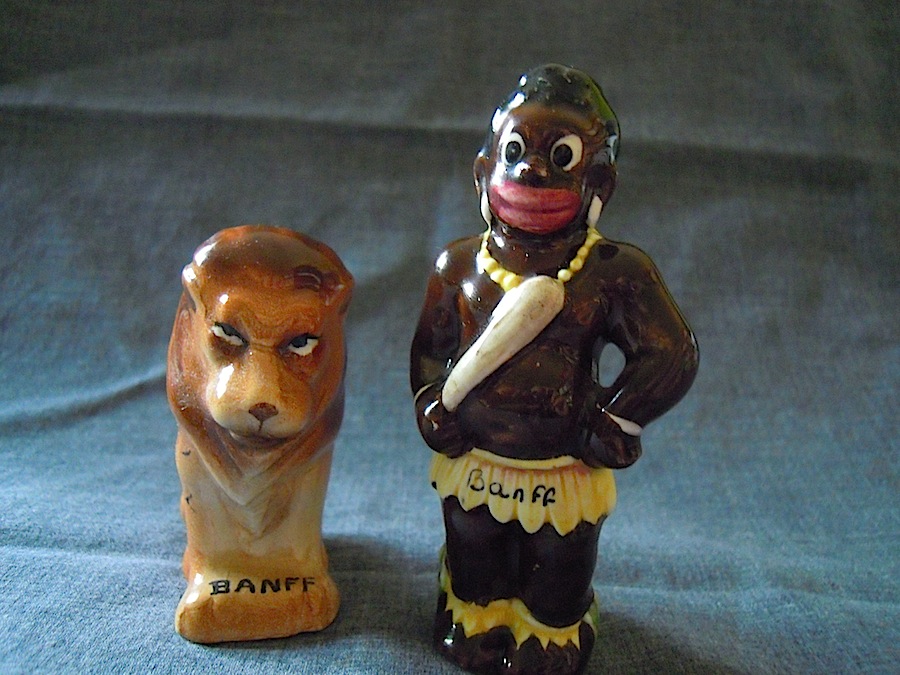 Since the human of this pair is wearing what looks sort of like a grass skirt, wielding a club, and accompanied by a lion rather than by a pancake-wielding woman, I presume he is supposed to represent, not an African American, but just an African period. He has, nevertheless, the same old fat red lips and round black eyes. The stereotype transcends national and even continental borders, it seems. And it’s interesting that it should be a lion accompanying him. They are either, or both, a hunter and what he hunts, or two equally savage, equally animal-like beings. Note, however, that both exude a form of cuteness, the hunter seeming, despite his club, sort of sweet and wide-eyed and adorable, and the lion doing his best to look dangerous with a strange sort of cutesy smirk. They are another good example of danger depicted but contained and diminished, made to seem merely cute and harmless.
 That right, Banff, Alberta, Canada, the resort in the Canadian Rockies–home of snow and skiing. Now what exactly a scantily-clothed African tribesman and a tropical beast of prey have to do with Banff I do not know. But I’ve already reported in earlier posts on other strange souvenirs from Banff: a pair of ungrammatical aboriginals, and a pair of golden hands. It begins to seem that when it comes to souvenir salt and pepper shakers, almost anything will do to represent a ski resort in the Rockies.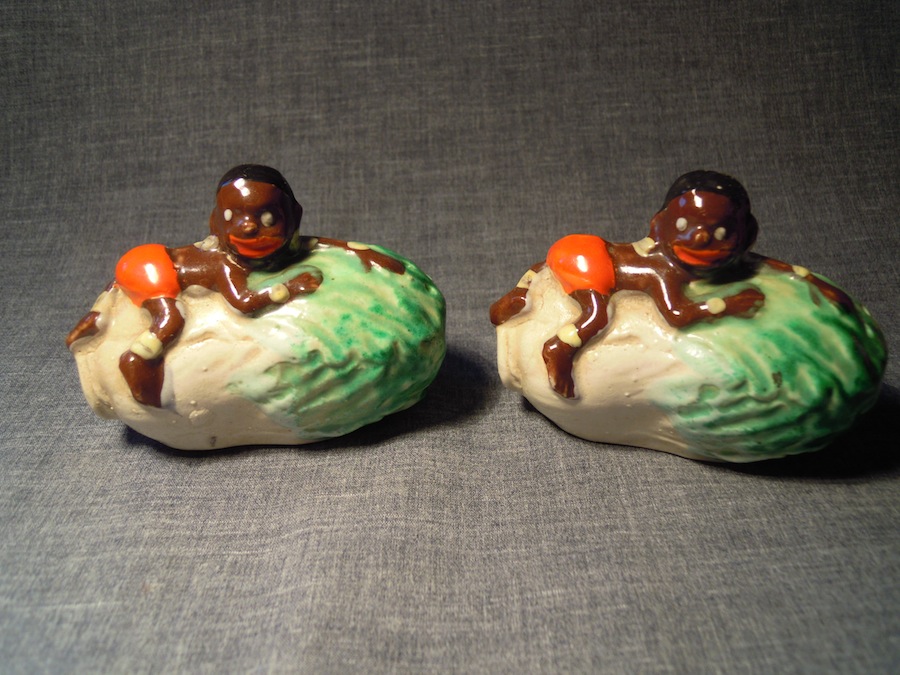





 Perry Nodelman
